Tuesday, May 17, 2011

Positioned for Stock Market Pullback

As commodity prices continue to pull back, I believe it is more and more likely that we enter a period of deflation since the scales in my previous analysis begin to tip towards price declines. This potentially has a material impact on stock valuations with an outlook of slower earnings growth and smaller PE multiples. It also favors bonds since the real yield on bonds will increase in a deflationary environment.

The length and depth of the deflationary period may be determined by the future actions of the Fed. If the Fed aggressively pursues QE3, then we could see a relatively short and shallow dive into deflation of under a year and less than negative 1% as measured by CPI starting in 2012. If the Fed chooses to let the markets run their course, then the deflationary period could be longer and deeper and stock market compression results in slower consumer spending due to a decline in wealth. Since I do not expect the Fed to voice any opinion on the QE3 for at least a few months, I believe the markets may increasingly factor in deflationary pressure going forward.


The PE multiple of the SP500
Source: http://www.multpl.com/

Borrowing from Schiller, the PE multiple of the SP500 is about 23x, relatively high compared to the mid-teen historical average. As outlined by Ed Easterling of Crestmont Research, during periods of stable prices the PE of the market increases. If, however, either inflation or deflation occur the PE of the market likely declines. See the following chart, which highlights the impact of inflation/ deflation of PE ratios.


Source: Crestmont Research

Under my sagflation thesis, I expect prices to fluctuate between inflation and deflation as fundamental economic forces and an activist monetary policy increase price instability. This implies wild gyrations in the stock market as the discounting of future earnings swings significantly due to changing expectations about future price trends and passes through the PE sweet spot of 0-4% inflation to either 5+% inflation or deflation, which typically result in low teens to single digit PE multiples.

So where is my money? A large weighting towards Treasuries with exposure to consumer staples whose costs likely decline, utilities in the domestic natural gas markets (where prices have remained low), tech companies with good dividend yields and that provide stable cash flow, fertilizer materials for growing food with a high dividend yield, and generic pharmaceutical.

The following is summary:

62% in 30-Year Treasury
6% IBM
5% BWP
5% KMB
4% TNH
4% FGP
4% CALM
3% UTL
2% TEVA
2% CA

Wednesday, May 11, 2011

Re-Positioned for Deflationary Market

In the previous post I broke down inflation/deflation pressures into seven categories, which were commodity, wage-price, financial assets, tangible assets, currency, fiat, and goods and services. Three were inflationary - commodity, financial assets and currency. Two were deflationary - tangible assets such as housing and fiat pressure resulting from federal fiscal and monetary policies. Two were relatively stable - wages and goods/ services. With the recent sell-off of commodity prices it appears as though volatile commodity prices may turn deflationary should the trend continue.

The market appears more concerned about inflation than deflation, however this may change dramatically should deflationary pressures spread to currency through a strengthening dollar, financial assets in a broad retrenchment of P/E, and goods/ services if the U.S. consumer slows spending.

In anticipation of this swing occurring in the markets, I have re-balanced my portfolio with heavy weighting to high quality U.S. bonds with a long duration (~40%) and relatively high dividend yield (>4%) stocks in the segments of consumer staples, domestic natural gas distribution, and productivity enhancing companies (~30%). I also remain about 25% in cash for a larger market correction.

Tuesday, April 26, 2011

Deflation's Turn!


Sagflation - Flattish real growth combined with more volatile prices. 

In this post I take a closer look at inflation versus deflation and come to the conclusion that deflationary pressures are building, which is contrary to Bill Gross's view and likely contrary to the equity market's more bullish outlook. As a result, I have entered a large position (~40%) in 30-year Treasuries. I will also likely move investments into more conservative segments going forward.

The debate over inflation and deflation rages on within the highest offices in the U.S., as highlighted by a WSJ article. A key quote by the president of the Federal Reserve Bank of New York is, "We think that it's important not to overreact to a rise in headline inflation because the increase in commodity prices is probably going to be temporary rather than persistent." As I argued in previous posts, I believe the inflation has been building from the bottom-up, as evidenced by the recent higher-than-expected PPI numbers. This trend is putting pressure on margins, a worry for earnings going forward. The question I explore in this post is whether the inflationary pressures are likely to continue to move up into the more visible CPI numbers, or deflationary pressure in the economy begins to exert more force. Under my sagflation thesis, I argue the future economy likely exhibits slow growth and increasingly volatile prices. Thus a turn towards deflation is not unexpected. 


The basic argument for tame inflation (or potential deflation) includes slack labor markets, excess world capacity, and deleveraging of high debt levels. The argument for inflation includes a highly expansionary monetary policy, rising commodity prices, and inflationary pressure in emerging markets spreading to the U.S..

In this entry I borrow the framework developed by A. Gary Schilling on inflation to breakdown the trends and hopefully glean a bit more insight into the future. His framework breaks down inflationary/ deflationary pressures into seven areas, which are commodity, wage-price, financial assets, tangible assets, currency, fiat, and goods and services. Mr. Schilling has argued a deflationary period is ahead for the world, most recently in his book published in late 2010 titled, "The Age of Deleveraging."

I argue that the fundamental trends should naturally lead to deflation but the Fed is using all its power to stave off deflation and thus causing inflationary bubbles to emerge in the economy, thus causing price volatility.

Commodity - Inflationary, but volatile
One of the larger investing stories over the past year has been the rise in commodity prices, most recently witnessed in oil prices and also cotton prices. These rises have pressured margins in many companies with more than a few finding ways to offset the pressures by improving efficiency, lowering quality or substituting a lower cost material. All that said, commodity prices are volatile and tend to swing as more supply comes on-line, investors make speculative direct invests, and demand changes. While difficult to forecast out one year, I suspect the commodity boom may begin to fizzle as high gas prices dampen demand, more supply is introduced, and investors begin to exit.


Wage-price - Flat
There remains significant slack in the work force since there are currently about 7 million fewer workers than four years ago. This slack has slowed the pace of growth in wages and salaries but the growth rate has started to pick-up again and remained positive throughout the recession. Wages continue to creep upwards, largely based on ingrained expectations of annual raises and at least a more stable jobs market. While wages have been increasing modestly, major consumer expenditures like gas and food have been increasing at a higher rate. Thus, the average U.S. worker has seen deteriorating purchasing power and thus is worse off in real terms. This is a deflationary pressure since spending becomes more tepid and even declines.


Financial asset - Inflationary
Financial assets have inflated in value over the past year as investors gain more conviction in their bullish outlook for the economy. In fact, the PE ratio based on the average of the trailing 10-years of earnings is nearing 25x, a level it had only reached once before the dot-com bubble but which appears to be a "new normal" expectation for the market.

                                                                Source: http://www.multpl.com/

The SP500 has rebounded strongly off its low and is back within 20% of its all-time high of close to 1,600. However, the earnings yield has continued to deteriorate to a negligible amount. In short, the market appears to anticipate an explosive economic expansion. In other words, the strong earnings growth must now carry the market higher, which may prove difficult as consumers spend more money on gas, food and debt service.

                                                              Source: Bigcharts.com


Tangible asset - Deflationary
The over-building in the housing market likely takes many years to work off, providing a significant deflationary pressure within the economy. Besides the over supply of houses and the tightening of mortgage lending standards, there is likely deflationary pressure from increased regulatory scrutiny, and potential tax changes that reduce the mortgage write-off benefit. 

The story in the commercial real estate market is more fundamentally balanced between demand and supply, although prices has been relatively weak since their peak in 2007 and continue to decline. More difficult financing, a weaker consumer economy, and some excess supply are the likely drivers of the price declines. That said, many experts believe the commercial real estate market is near a bottom as businesses begin to hire again. New REITs are being formed in anticipation of a rebound, which provides some pause that the near-term stabilization is driven more by speculative buying by investors than fundamental demand growth. That said, if consumers revert to loading up on debt then the economy likely continues to rebound and commercial real estate likely performs well.
 

Currency - Inflationary
As the US dollar has declined, imports have become more expensive while exports and foreign revenue have benefited. The weaker dollar has encouraged inflation in commodities and within countries that somewhat link to the dollar, such as China. It is important to remember that imports account for less than 20% of GDP and thus inflationary pressure from imports is relatively modest. As a result, the weak dollar's impact on revenue has been fairly muted but the impact of higher costs has pressured margins.


It is difficult at this point to predict the impact of the end of QE2 on the dollar since there are fierce debates about QE2's impact on both treasuries and economic growth. I expect the dollar to continue a longer-term trend of decline, driven by weaker economic growth within the U.S., on-going accommodative monetary policy relative to foreign countries, and increasing viability of the Chinese yuan in international trade.

Inflation by fiat - Turning Deflationary
The aggressive deficit spending during the past ten years to fund the "war on terror" and then to offset the "great recession" was inflationary in nature. The state and local governments also fueled inflationary pressures as they expanded expenditures, funded by higher property tax revenue and the accumulation of debt. With the aggressive spending cuts expected by the federal government due to the leverage of the Tea Party, I expect the inflationary pressure to turn deflationary. With less federal money flowing to the states, increasing pressure to make-up losses in pensions, and declining property values, the spending at the state and local level also likely decreases. The threat of a downgrade of the rating of U.S. debt likely hastens the deflationary action of the government. Less spending means less demand, which means deflation.


The future actions of the Federal Reserve is always difficult to predict, and can actively offset fundamental pressures. However, the massive stimulation provided by the Fed
is coming to an end, and may even reverse if they decide to sell securities, although a reversal seems doubtful in the near future as the Fed Chairman remains concerned about deflation. Unless the Fed continuously "raises the ante" by increasing the level of stimulus, I believe the Fed's actions likely cannot offset the fundamental deflationary forces in the economy.

Additionally, foreign governments have actively raised rates and reserve requirements in efforts to slow down inflationary pressures in their countries. These efforts likely start putting a brake on world economic growth.

Goods and services - Stable Short-term, Deflationary Longer-term
Good and services likely resume their deflationary trend in the one to two years due to improvements in productivity, excess manufacturing capacity in many industries, and excess retail units that encourage competition. Offsetting these longer-term trends are higher commodity prices, which have increased PPI, and the disruption to the supply caused by the earthquake in Japan. Already businesses in the high tech and automotive industries are managing through shortages of parts. In fact, the earthquake may actually cause a near-term bump in the sales of some suppliers due to buyers increasing inventory in anticipation of parts shortages.

Tuesday, April 12, 2011

Earn It!

Interesting article in the WSJ discussing "The Dark Side of Strong Corporate Earning." In the article the author Kelly Evans highlights that the uptick in corporate profits has not produced accelerating GDP growth. The reason, she argues, is that companies' earnings are increasingly driven by strength outside the U.S. She also points out that the capital stock in the U.S., things like factories, power plants and equipment, declined in 2009 for the first time in postwar history. The level of capital stock appears to have rebounded in 2010, but largely due to maintenance investments. In many ways the decline in capital stock is not surprising given the almost 15-year decline in capacity utilization. In light of capacity utilization, it is somewhat surprising a decline in one year has not happened sooner.


Increasing investment in capital stock is critical to a healthy and growing country. Simply put, no factories, no offices, and no power plants means a very limited economy. So why has capital stock growth leveled off? You could point to the rise of competitive products from emerging markets, offshore outsourcing of services, movement of U.S. manufacturing to cheaper labor regions, or even relatively high corporate tax rates in the U.S. To me, it boils down to declining returns on the capital stock, which encompasses all these macroeconomic issues and also over-investment during the past 15-20 years fueled by inexpensive debt. In other words, we have been "whistling past the graveyard" of our own weakening competitiveness for some time.

How has the U.S. responded to this problem? Some responses have been knee-jerk reactions with protectionist tariffs, laws and immigration restrictions that ultimately hurt the economy. Others have been semi-thoughtful efforts to improve the competitiveness of U.S. exports through exchange rates. These more thoughtful efforts range from obvious complaints leveled at intervention by other countries to more subtle dollar devaluation through expansionary monetary policies (wrapped in stimulative/ fend of the end of the world rhetoric).

The most effective, although the longest to implement and realize a return, are the efforts to encourage domestic investment in industries with potentially high growth products and services with high foreign demand. I emphasize high foreign demand to separate out companies like local casinos that draw from populations and provide little, if any, overall value add to society. Greater value comes from idea-generating industries with large global markets, manufacturing businesses that export products, and services that draw foreign dollars. The point is a basic one, America must return to increasing the value added to the world economy. We demand among the highest wages in the world. President Obama hit on it in 2009 when he referenced the old Smith Barney ad "earn it."

Thursday, April 7, 2011

Debt! (Fire!)

 Event
At some point over the one-to-two months the debt level of the federal government will likely exceed the current debt ceiling. The federal government is currently politicking their way towards a federal budget, with the focus on cutting around $40 billion from non-entitlement non-defense spending. This portion of the budget accounts for about 12% of the federal budget. Unless some compromise is reached before the end of the week the federal government shuts down. Of course the predictable fingers from the left and the right are pointing at the other side. As a reminder, this is just the opening act in what promises to be a brutal battle over entitlements, tax rates, and government services.

Worst case scenario, a government shut down and the debt ceiling is not raised, which implies the U.S. Treasury cannot legally issue additional debt to finance the expenditures of the country. This scenario likely leads to some rather unpleasant outcomes, like higher interest rates and drastic cuts in entitlement programs that hastens an economic slowdown. Best case, a budget compromise is realized that appeases the majority, the debt ceiling is raised, and politicians tackle the rest of the budget in a responsible manner. This scenario likely extends the current bubble period and buys the country another year to deal with the fundamental problem - debt.

Analysis
So what is likely the road forward after this is resolved in DC? To start, let's focus on the root of the problem - debt. The Total Debt Outstanding for the U.S. government has increased to almost 100% of the annual GDP. This level has increased over the past 30 years from well under 40% in the early 1980's. This path is clearly unsustainable.

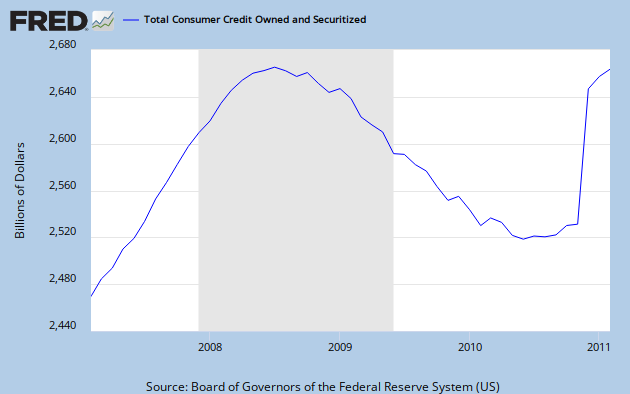
For U.S. consumers the picture is even bleaker. About three quarters of the U.S. economy is driven by consumer purchases, thus any change in consumer spending has a material impact on the economy. True, debt levels did decrease during the recession (likely causing the recession), but in the last quarter they started to rise again (likely helping the perceived recovery).


What has encouraged the U.S. consumer to start loading up on debt again? Easy money. The Fed has flooded the economy with money to offset a tighter lending environment by banks, lower interest rates, and to stimulate economic growth. The following graph is startling:
Note: Adjusted Monetary Base is defined as the sum of currency in circulation outside Federal Reserve Banks and the U.S. Treasury, deposits of depository financial institutions at Federal Reserve Banks, and an adjustment for the effects of changes in statutory reserve requirements on the quantity of base money held by depositories.

Adding fuel to the fire - the majority of banks are loosening lending standards, thus providing greater incentive to consumers to increase debt levels.


Summary

The U.S. economy is driven by consumer spending. The consumer has started to again increase debt levels in order to maintain a consumption level able to drive economic growth since income and asset appreciation has not grown dramatically. The Fed has completed Herculean efforts to keep the economy moving by convincing the consumer to keep buying. At some point the music stops. Sagflation (flat-to-negative real growth + volatile prices) settles in further as fundamental deflationary forces driven by deleveraging are battled by active inflationary actions taken by the Fed. Bubbles form and pop, politicians seesaw policy between extremes, and businesses suffer in an increasingly unstable world. How long the Fed can keep the music playing is anyone's guess, but the end game is likely debilitating inflation pressures, severe economic retrenchment, or both. Sagflation.


The challenge will be to identify investment strategies in this world.

Wednesday, March 30, 2011

Interesting editorial in the Journal, "Investment Strategy: All About the Benjamins," in which Mark Spitznagel breaks down the classic debate about market efficiency between Ben Bernanke (efficient) and Ben Graham (inefficient). One of Mr. Spitznagel's main points of differentiation is:

"Among their (Bernanke and traders) rallying cries is the expectation that stock price volatility, when positive, will magically and recursively improve the very fundamentals being priced (the "wealth effect"). Meanwhile, Graham investors have stoically stepped aside."

Mr. Spitznagel uses the Tobin's Q ratio to develop his point, which he highlights has recently surpassed all historical highs other than the 1990's. Highs usually foretell lower market prices.

I love this type of return-based analysis because I firmly believe that expected future returns explain over 90% of the market valuation. Through detailed bottoms-up analysis of almost 100 companies I have shown this to be true in the restaurant, software and security industries.

A high Q ratio is basically saying the market expects returns produced by companies to improve. So here we find ourselves at the heart of the question, which is: Are returns going to improve to meet market expectations. Mr. Spitznagel argues that Ben Graham would simply step aside since expectations appear high while Ben Bernanke uses the expectation of improving returns as a signal the economy is improving and producing the beneficial wealth effect

So here is THE question, in my mind: Has the U.S. changed structurally to ensure sustained economic growth, or are the recent data points of economic recovery sending nominal signals?

A couple data points:
(1) Housing prices dropped 3.1% in January, due, in my opinion, to excess inventory from the boom and rising borrowing costs associated with higher fees, greater regulation and potentially the removal of federal housing incentives like Fannie/ Freddie and mortgage tax deductions. 
(2) Consumer borrowing accelerated in January to an increase of 2.5% after declining in 2009 and 2010, due to a 6.9% increase in non-revolving debt for items such as automobiles. The interest rate charged by commercial banks for 48-month loans on new cars has declined from 6.55% in 4Q09 to approximately 5.87% in 4Q10. Revolving debt for consumers, which includes credit cards, decreased 6.4% in the month.
(3) Money supply has increased significantly over the past year. M1 has increased 10% and M2 is up over 4%.
(4) Retailers increasingly are raising prices to offset rising costs. Merchants who cannot raise prices, or are poorly positioned, are likely squeezed out.
(5) Oil prices above $100 per barrel and average pump prices above $3.50.

I have to admit I haven't felt strong conviction about stock prices during 2011, due mostly to an internal tug-of-war between a short-term inflation fueled rally versus a long-term sagflation malaise. With the disruptions in the supply chain associated with the events in Japan and the on-going tension in the middle east driving up oil prices, I am now tilting more towards inflation proof points showing up in the economy before year-end. Inflation combined with highly competitive consumer markets (ie. excess capital) suggest flattish real economic activity and therefore I remain more on the bearish side of the fence. Therefore my 30+% cash position seems to fit my macro style, even if it has caused under performance for the first quarter.

Tuesday, February 8, 2011

Stopped Banging Head Against the Wall!

Alright, sold all of my position in VIX Mid-Term Futures (ticker: VXZ) at $53.60. Took a bath on it as the market has consistently appreciated almost every day this year. Originally I had established the position to hedge a possible market correction after a strong rally through the end of the year. Well, that obviously didn't happen. Even more frustrating, I've been expecting the market to show a strong rally through the first half of the year. So I successfully positioned myself against my 6 month expectations, and then got stubborn about it. So I start 2011 in a hole (down about 1%) and will need to climb back out.

Going forward looking for investment vehicles with:
(1) Pricing power as I expect costs to rise for many businesses. If they can pass along these increases then revenues should grow more rapidly than expected and margins should remain fairly stable.
(2) Beneficiaries of higher commodity prices, likely increasing U.S. interest rates, and pent-up demand.
(3) Larger cap companies trading at attractive valuations with high returns and growth prospects.