In this article I argue that we may be reaching an end game for monetary policy. As economies continue to sputter and the central banks continue to pursue extraordinary measures, the question should be raised: What are we accomplishing? And, at what long-term cost?
There is little doubt the Federal Reserve's quantitative easing policy has helped bolster asset prices, especially prices for bonds, equity and houses. The U.S. stock markets sit around record highs, treasury yields are near record lows, and interest rates on mortgages are near record lows. These factors have created a "wealth effect" in which owners of these assets feel better off.
The question is: Does this asset appreciation mean we reach an "escape velocity" for the economy or does it set us up for greater volatility (ie. another burst bubble)?
Time will prove the fairest judge of this debate. But for now, maybe the biggest long lasting impact of recent monetary policy has been in the area of academia. Through Mr. Bernanke's tinkering we are learning about the limitations of monetary policy. It is becoming apparent that monetary policy has a direct impact on asset prices but the impact on labor markets and consumer spending is more indirect, and potentially dominated by other factors. Similar to a whip, Bernanke applies force to one end with the expectation of a "crack" at the other end. Will the monetary force used to lift asset prices result in a Bernanke-Jones whip-like economic snap or a Bernanke-Tube Man violation?
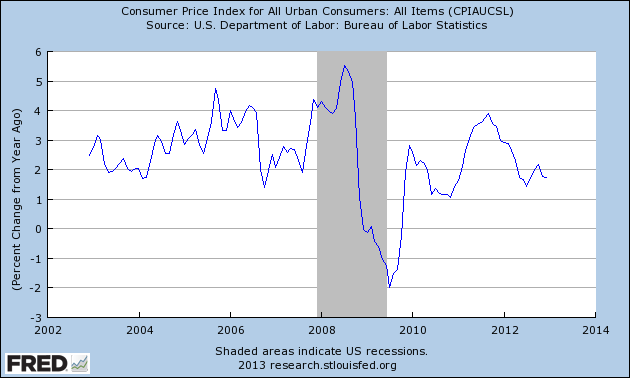
The declining velocity of money and slowing growth in the money supply suggest more of a tube man blowing hot hair than Indiana Jones getting the treasure (and girl). Slowing velocity and slowing monetary base growth equals slowing nominal GDP. In other words, inflation risk is declining and deflation risk is increasing, supported by weak gold prices and TIPS.
Recent economic releases continue to paint a mixed economic picture. Consumer spending appears weakening, with cash-register sales declining 0.4% in March. Consumer sentiment fell to the lowest level in nine months. Retailers are actually cutting jobs. The reasons for this weakness are varied, including rising healthcare costs consuming more of a family's budget, rising income taxes, falling mortgage refinancing activity as rates have been at a prolonged nadir, and federal sequestration.
The recent weakness in bank earnings, and the nearing end of lowering loan-loss reserves to bolster earnings, may provide a clearer picture of the strength of the economy. In an ultra low long-term rate environment it is challenging for financial companies to produce acceptable returns. Even more concerning, a research article by Robert C. Merton highlights that due to explicit and implicit government guarantees bank earnings face a "doubly convex" curve, masking the real risk to banks' earnings when the economy worsens and increasing economic volatility. So what seems like satisfactory risk controls in a normal environment can quickly deteriorate into a crisis during an economic downturn.
Central banks are raising the stakes in their battle to drive economic growth, a notion that should cause more skepticism. Most recently, Japan's central bank has committed to expand its balance sheet through asset purchases at the rate of 1% of GDP each month, potentially doubling the base money within two years. This policy is expected to continue for as long as necessary. All of this to offset a naturally deflationary environment caused by an aging population and a relatively inflexible economy. Are central banks lifting us to a recovery or simply holding on as more weight is added to a recession scenario?
Rising prices are not a major contributor with most commodity prices flat to down, including major influences like gasoline and food. Countries that have traditionally relied on commodity exports have been experiencing weakness, including Canada and Chile. In fact, with a consumer debt level to disposable income at a record level of 165% and oil revenue $6 billion below expectations, there is growing concern in Canada that the economy will continue to weaken.
In an environment in which some have characterized as a "no bad news" environment for markets, there is a deep fundamental belief that the monetary policy can cure all. In a perverse way, bad labor market statistics actually encourage the markets because the likelihood of the Fed extending its easing stance increases. Great for the asset markets but maybe not as much so for the economy, especially when growing risks of price destabilization, either inflationary or deflationary, are considered
The markets continue to skip down the path paved by the Bernanke-the-wizard's dollars. Take away that dollar-covered curtain and the picture is down right scary.
Showing posts with label deflation. Show all posts
Wednesday, April 17, 2013
Monday, February 4, 2013
Economic Growth of 4% in 2013?
A few predictions for 2013
How can I be so sure in my "prediction?" Because I believe that price stability is the largest threat to the economy, and therefore 2013 nominal GDP has such a wide potential range that predicting its growth is no better than a game of darts. Following on from my last article, the Federal Reserve has done a masterful job so far at balancing the fundamental deflationary forces in the economy with the inflationary forces of the QE strategy. But, their path is narrowing and their control loosening, in my opinion.
Fundamental deflationary forces are coming from trends like:
Hold onto your hats because I believe the markets have been lulled into a feeling of "the Fed has our backs," allowing that silent killer called risk to creep further into our economy, likely producing large price swings in my view. Let us just hope that Mr. Bernanke is as cunning and well-equipped as the Roadrunner when the silent killer of risk sneaks up on investors.
- Global economic growth of 3.5%, accelerating from 3.2% in 2012 (Source: IMF)
- US economic growth of 2.0%, accelerating to 3.0% in 2014 (Source: IMF)
- US Retail sales growth of 3.4%, with on-line sales growth between 9% to 12% (Source: NFR)
How can I be so sure in my "prediction?" Because I believe that price stability is the largest threat to the economy, and therefore 2013 nominal GDP has such a wide potential range that predicting its growth is no better than a game of darts. Following on from my last article, the Federal Reserve has done a masterful job so far at balancing the fundamental deflationary forces in the economy with the inflationary forces of the QE strategy. But, their path is narrowing and their control loosening, in my opinion.
Fundamental deflationary forces are coming from trends like:
- Technology advancement
- Excess capital in industries like retail
- Mis-allocated capital as banks postpone write-offs of under-performing loans
- A leveraged consumer based on debt to income
- Flat real income
- Rising taxes paid on income, reducing disposable income
- More controlled government spending, especially in Europe and wind-down of wars
- Raising income after interest expense through lower interest rates
- Encouraging capital investment by lowering the cost of capital
- Inflating both financial and tangible asset prices through direct purchases and lower financing
Hold onto your hats because I believe the markets have been lulled into a feeling of "the Fed has our backs," allowing that silent killer called risk to creep further into our economy, likely producing large price swings in my view. Let us just hope that Mr. Bernanke is as cunning and well-equipped as the Roadrunner when the silent killer of risk sneaks up on investors.
Wednesday, January 23, 2013
Federal Reserve On Road to Vanishing Point?
Vanishing Point - In art, the point on the horizon line at which
any two or more parallel lines seem to meet.
For this article, the space between the two lines represents the road of Quantitative Easing with price stability, the space to the left - deflation, and the space to the right - inflation. The longer the Federal reserve extends QE into the future, the harder it becomes to maintain price stability, ultimately proving unsustainable at the vanishing point. Our position remains fixed as we watch the Fed drive down the road.
In summary, price stability appears right in the middle of the road, and thus a primary reason why the stock markets have performed well, in my view. The risk is that the road is narrowing and the Federal Reserve's steering is becoming looser.
Deflationary - Commodities, Wage-Price
Neutral - Currency, Fiat, Good and Services
Inflationary - Financial Assets, Tangible Assets
In this entry I again borrow the framework developed by A. Gary Schilling on inflation to breakdown the trends and hopefully glean a bit more insight into the future. His framework breaks down inflationary/ deflationary pressures into seven areas, which are commodity, wage-price, financial assets, tangible assets, currency, fiat, and goods and services.
Commodity - Deflationary
Wage-Price - Deflationary, but Possibly Recovering
If income growth is flat-to-down, then the only way demand for goods and services can increase is if either debt levels go up (savings go down), or prices go down. Not surprisingly, the radio station WBUR highlighted that breaks in income streams has increasingly contributed to greater financial difficulty amongst consumers.
Indeed, total consumer credit has steadily increased over the past couple years. The main driver of the growth in consumer credit is non-revolving credit, for credit for categories like automobiles, education. As total credit per capita increases, and income remains stagnant, the purchasing power of the consumer declines unless interest rates continue to decline. Alternatively, for a period of time consumption can continue if asset prices are increasing, enabling cash infusions from rising equity in homes and other assets. While debt continues to rise, I believe we are nearing the end game of both falling interest rates and rising home equity.
Financial Assets - Inflationary
Tangible Assets - Inflationary
House prices have been rising, and expectations about the rate of growth have been rising over the six months. This rise in expectations is likely the direct result of the Federal reserve purchasing mortgage-backed securities, pushing mortgage rates lower. Lower rates mean a person can afford to pay more for a house with the same income level. If banks loosen lending standards then the trend in housing prices may accelerate higher as another housing bubble is inflated.
If major banks like Bank of America begin to aggressively go after new lending business then this category may provide a major inflationary force in the economy as banks draw down reserves in order to make loans, increasing the money multiplier and thus the amount of money in circulation.
Currency - Neutral
The US dollar continues to hold up fairly well relative to most other major currencies. This resilience is largely due to the aggressive monetary policies by most foreign central banks, although there is some puzzlement. In addition, the large reserves held by banks has so far reduced the multiplier effect, and thus the actual amount of money in circulation is not nearly as high as the potential. The potential inflationary force of a weaker dollar is likely held in check so long as the US dollar holds its value relative to other major currencies and banks remain conservative with their reserves.
Fiat - Uncertain, but Leaning Deflationary
How the debate about the overall role of government plays out likely determines whether this swings inflationary or deflationary. If the gridlock has accomplished anything, it has allowed the status quo to remain in place, neither applying further inflationary pressures through growing deficits nor swinging to deflationary pressures through austerity measures.
Clearly the Republicans prefer the road of austerity through reduced spending, although have accepted limited tax increases to avoid the "fiscal cliff." As we have seen in Europe, this path likely causes an economic slowdown in the near-term with deflationary forces. The Democrats don't want to cut spending and seem a little more accepting of deficit spending in order to spur economic growth, although higher taxes are clearly a part of their argument.
Across the Pacific is Japan, which has pursued endless rounds of stimulus to drive economic growth, only to pile national debt up to 2.5x GDP. Japan has been described as "a fly looking for a windshield," splat is only a matter of time with an aging population and mounting debt. Across the Atlantic is Europe, which has been taking its medicine through more austere measures and seen GDP growth fall. So long as the social and political structures remain in place, Europe should emerge stronger in the long run after a painful retrenchment.
If the "grand bargain" becomes additional higher taxes coupled with lower spending, then this segment swings definitively deflationary. If spending is not cut, and even increased to stimulate the economy, then this segment applies inflationary forces to the economy. More than likely, since the deficit has been trending down, the government agrees on moderate spending cuts. Simply reducing the spending on the war effort should be considered deflationary. Of course, Congress may not increase the debt ceiling and federal spending in indiscriminately and severely cut.
Goods and Services - Neutral
The combination of flat income and rising non-revolving debt balances leaves weaker consumer spending on items typically purchased with credit cards, either discretionary or non-discretionary. It is possible that more aggressive mortgage lending practices by banks may enable home prices to rise, thus providing home owners with larger equity balances with which to spend on goods and services. However, I fear that driver would only lead to another economic shock as US consumers are already tapping 401k balances to pay monthly bills.
Has the supply of retail declined, thus enabling a rise in prices due to lessening competition? The answer is simply "no." If anything, the American consumer remains over-supplied with stores, as highlighted by the recent weakness in retail REITs focused on strip malls. This over-supply of retail outlets reduces pricing power amongst retailers and provides a deflationary force to the economy. Lower mortgage payments through re-financing and tepid economic growth have so far kept the supply-demand dynamics in balance.
AIER's EPI - Everyday Price Index
Source: https://www.aier.org/epiFriday, January 11, 2013
America the Producer?
In my last article I highlighted the following:
What I do find interesting is an apparent shift in manufacturing between goods produced domestically versus overseas. Due to a number of economic forces, both macro and micro, there is the beginning of a shift towards domestic manufacturing, in my opinion. Numerous individuals have argued this trend recently, highlighted by Charles Fishman in the December edition of The Atlantic. Indeed, after manufacturing output rose 10% in the first quarter of 2012 the trumpets sounded about America's manufacturing resurrection, only to fall flat for the remainder of the year. So this trend is by no means certain and definitely not smooth. With that said, I plan to explore the argument further.
Macro forces pushing a shift away from overseas to more domestic manufacturing include:
Macro forces paired with fundamental business interests should eventually make for a powerful trend, in my view. Furthermore, the President is also focused on improving the manufacturing capabilities of the country, and thus political interests are aligned with economic trends. Finally, the on-going efforts of the Federal Reserve likely continues to weaken the US dollar over the long-term, adding further support to moving manufacturing back within domestic borders.
So there appears a fairly complete argument driving the growth of domestic manufacturing above GDP growth. The key phrase is "above GDP growth."
The consensus seems to tilt towards healthy GDP growth in 2013, driving favorable earnings growth. The key assumption supporting these views, in my view, is price stability. Given the Federal Reserve's decent track record over the past few years to balancing the deflationary and inflationary forces in the economy (where I have been wrong in my investment thesis), I believe assuming price stability in 2013 is the easy argument. However, changes in fiscal policy and increasing discord within the Federal Reserve may result in more volatile prices going forward. In the next few articles I plan to look into the following topics:
(1) The assumption of price stability
(2) Expected economic growth
(3) Interesting companies likely benefiting from domestic manufacturing
- The Bush-era lower taxes have added a general stimulus to the economy, enabling individuals to purchase more products and services because of a higher after-tax income.
- The larger government outlays as a percentage of GDP have driven growth rates above what is naturally sustainable in segments like defense and construction; and has enabled a woefully inefficient healthcare industry rife with fraud and over-billing.
- The aggressive monetary policies that have fueled falling interest rates have added significant stimulus to the economy, especially in industries requiring debt financing like housing and autos.
What I do find interesting is an apparent shift in manufacturing between goods produced domestically versus overseas. Due to a number of economic forces, both macro and micro, there is the beginning of a shift towards domestic manufacturing, in my opinion. Numerous individuals have argued this trend recently, highlighted by Charles Fishman in the December edition of The Atlantic. Indeed, after manufacturing output rose 10% in the first quarter of 2012 the trumpets sounded about America's manufacturing resurrection, only to fall flat for the remainder of the year. So this trend is by no means certain and definitely not smooth. With that said, I plan to explore the argument further.
Macro forces pushing a shift away from overseas to more domestic manufacturing include:
- Higher oil prices, increasing shipping costs
- Lower natural gas prices in the US, reducing domestic manufacturing costs
- Rising China wages, which have increased five-fold since 2000 in US dollars
- Slack US labor markets and weakened unions in the US, enabling lower domestic labor costs
- Rising US labor productivity, enabling lower domestic labor costs
- Falling dollar relative to China Yuan, making Chinese products more expensive
Macro forces paired with fundamental business interests should eventually make for a powerful trend, in my view. Furthermore, the President is also focused on improving the manufacturing capabilities of the country, and thus political interests are aligned with economic trends. Finally, the on-going efforts of the Federal Reserve likely continues to weaken the US dollar over the long-term, adding further support to moving manufacturing back within domestic borders.
So there appears a fairly complete argument driving the growth of domestic manufacturing above GDP growth. The key phrase is "above GDP growth."
The consensus seems to tilt towards healthy GDP growth in 2013, driving favorable earnings growth. The key assumption supporting these views, in my view, is price stability. Given the Federal Reserve's decent track record over the past few years to balancing the deflationary and inflationary forces in the economy (where I have been wrong in my investment thesis), I believe assuming price stability in 2013 is the easy argument. However, changes in fiscal policy and increasing discord within the Federal Reserve may result in more volatile prices going forward. In the next few articles I plan to look into the following topics:
(1) The assumption of price stability
(2) Expected economic growth
(3) Interesting companies likely benefiting from domestic manufacturing
Tuesday, December 18, 2012
Forget Fiscal Cliff! Can the Economy Grow in Five Years Without Government Stimulus?
I don't know about you, but the hysteria about the fiscal cliff is beginning to really rub me raw. It is not so much the politicians doing their dance. It is instead the distraction from the larger fundamental question of: "What is right for the long-term health of the economy?"
After a big step back, let's consider what deficit spending has meant to the economy.
The amount of taxes paid, as a percentage of GDP, has declined almost 5% of GDP to 15.8%. In other words, instead of paying money to the government, individuals have been purchasing goods and services, a stimulant for the economy. Secondly, government outlays have increased over 6% of GDP to 24.3%. A significant stimulant to the economy has been higher government spending, especially in the area of healthcare.
One can argue that these figures suggest more stimulus is needed in order to avoid an economic slowdown. Indeed, there are economists on the left-side of the spectrum advocating up to $2 trillion of additional stimulus spending in order to grow the "denominator," or GDP. The basis of the argument is that cutting the government deficit produces a 1-to-1 reduction in the private surplus, hurting the economy as witnessed in Europe under austerity measures. Yes, we are talking defined formulas for calculating GDP. Also, intuitively it makes sense that slowing government spending or raising taxes will be a drag on the economy, just as the opposite was true during the last decade.
Source: New Economic Perspectives
However, this raises the philosophical question of whether the government should be the main driver of economic growth for an extended period of time. The government can obviously drive growth, but when pursued for a decade how does this type of growth driver pervert private economic activity? President Obama has maintained budget deficits in excess of 7% of GDP during his term in office. While this has helped avoid a more catastrophic depression, I fear it is also increasing systemic risk as companies increasingly rely on both government spending and lower income and capital gains taxes, either directly or indirectly.
Where I respectively disagree is sustainability of these policies. Economists advocating stimulus spending generally argue that by growing GDP through deficits, the economy can reach a self-perpetuating growth rate, at which point the government can remove stimulus spending and on-going growth can then pay down the debt. Based on this theory, you would think after 4 years of historically high deficits the economy would have performed better. In fact, the only period in the last 10 years of fiscal stimulus that has approached "normal" economic activity was the result of an inflating housing bubble that proved short lived. I suppose an ever increasing deficit and increasingly aggressive monetary policy can keep the economy growing, but there may be a diminishing impact on GDP growth as inefficiencies in the economy are allowed to remain.
The budget deficit as a percentage of GDP has been 10.1%, 9.0%, 8.7% and 7.0% for 2009 through 2012, respectively. To put this in perspective, the largest budget deficits since WWII were a little over 5%, which only happened twice. In 2013, the budget deficit is forecast between 5.5% to 6.0%.
Again, let's review some numbers:
Why does the US benefit from ultra-low interest rates while other countries with a slightly higher debt-to-GDP have interest rates spike upwards? One of the main reason, in my opinion, is because of the Fed's bond buying. However, the size and strength of the US economy, a focus mostly on public debt, falling debt service payments, and the view of the dollar as a safe currency play important roles. But, the disparity in interest rates has caused some head-scratching. I believe my Sagflation theory helps to explain this issue through the combination of fundamental deflationary forces offset by expansionary monetary policies, both of which are pushing interest rates lower.
So debt levels have been rising. At what level does the bond market pull back from US debt is very much debatable. I will leave it by stating the obvious, the higher the leverage ratio the less forgiving is the bond market if the economy slows. Stimulative policies that raise the leverage ratio increase the risk of interest rates spiking should the economy slow before the debt can be reduced.
Why I Continue to Remain Bearish
Returning to two points made previously, and adding one more. Since 2000, the following has happened in the economy:
The larger government outlays as a percentage of GDP have driven growth rates above what is naturally sustainable in segments like defense and construction; and has enabled a woefully inefficient healthcare industry rife with fraud and over-billing. The growth rates in these industries likely moderate, although healthcare may prove more resilient given the changes to the healthcare laws.
The falling interest rates have added significant stimulus to the economy, especially in industries requiring debt financing like housing and autos. Not surprisingly, both the housing market and auto industry has enjoyed a lift as the Fed aggressively purchases treasuries and mortgage-backed securities.
The critical question, in my mind, and the one everyone is fighting over is this:
Is the economy structurally efficient for the long-term?
Hard to answer this question, but I think the fundamental deflationary forces, shadowed by excessive bank reserves, hint at over-supply and poor returns in many industries. Structurally the tax code is inefficient and this constant whining from business leaders about "uncertainty" in Washington hints of businesses too closely tied to the government and its policies. Finally, the rising amount of poorly written regulation as the government reacts to crises is likely having a cooling effect on the economy.
Mr. Bernanke can keep the growth engine bouncing along as the Fed's balance sheet now exceeds $3 trillion, and in many ways he is doing what is necessary to avoid a deflationary death spiral. But, until the government enables the economy to become more efficient I believe we are doomed to Stagflation.
So while the federal government pursues stimulative measures the markets likely respond favorably. These policies could continue throughout President Obama's term in office. However, the exit of these policies becomes riskier as the debt balance rises and the Federal Reserve's balance sheet inflates. For a fundamental analyst, it is tough to swallow any company-specific analysis when the foundation of the economy seems softer and riskier than ever before.
After a big step back, let's consider what deficit spending has meant to the economy.
| % of GDP | 2000 | 2012 |
| Total Government Receipts | 20.6% | 15.8% |
| Total Government Outlays | 18.2% | 24.3% |
The amount of taxes paid, as a percentage of GDP, has declined almost 5% of GDP to 15.8%. In other words, instead of paying money to the government, individuals have been purchasing goods and services, a stimulant for the economy. Secondly, government outlays have increased over 6% of GDP to 24.3%. A significant stimulant to the economy has been higher government spending, especially in the area of healthcare.
One can argue that these figures suggest more stimulus is needed in order to avoid an economic slowdown. Indeed, there are economists on the left-side of the spectrum advocating up to $2 trillion of additional stimulus spending in order to grow the "denominator," or GDP. The basis of the argument is that cutting the government deficit produces a 1-to-1 reduction in the private surplus, hurting the economy as witnessed in Europe under austerity measures. Yes, we are talking defined formulas for calculating GDP. Also, intuitively it makes sense that slowing government spending or raising taxes will be a drag on the economy, just as the opposite was true during the last decade.
Source: New Economic Perspectives
However, this raises the philosophical question of whether the government should be the main driver of economic growth for an extended period of time. The government can obviously drive growth, but when pursued for a decade how does this type of growth driver pervert private economic activity? President Obama has maintained budget deficits in excess of 7% of GDP during his term in office. While this has helped avoid a more catastrophic depression, I fear it is also increasing systemic risk as companies increasingly rely on both government spending and lower income and capital gains taxes, either directly or indirectly.
Where I respectively disagree is sustainability of these policies. Economists advocating stimulus spending generally argue that by growing GDP through deficits, the economy can reach a self-perpetuating growth rate, at which point the government can remove stimulus spending and on-going growth can then pay down the debt. Based on this theory, you would think after 4 years of historically high deficits the economy would have performed better. In fact, the only period in the last 10 years of fiscal stimulus that has approached "normal" economic activity was the result of an inflating housing bubble that proved short lived. I suppose an ever increasing deficit and increasingly aggressive monetary policy can keep the economy growing, but there may be a diminishing impact on GDP growth as inefficiencies in the economy are allowed to remain.
The budget deficit as a percentage of GDP has been 10.1%, 9.0%, 8.7% and 7.0% for 2009 through 2012, respectively. To put this in perspective, the largest budget deficits since WWII were a little over 5%, which only happened twice. In 2013, the budget deficit is forecast between 5.5% to 6.0%.
Again, let's review some numbers:
- US Debt Held by Public - $11.5 trillion (~ 75% of GDP)
- US Debt Outstanding - $16.3 trillion (Greater than 100% of GDP)
- Estimated US Debt Outstanding 2016 - $22.8 trillion (~ 150% of GDP)
- Total Liabilities of US Government (Soc Sec, Medicare, Govt pensions) - $86.8 trillion (550% of GDP)
Why does the US benefit from ultra-low interest rates while other countries with a slightly higher debt-to-GDP have interest rates spike upwards? One of the main reason, in my opinion, is because of the Fed's bond buying. However, the size and strength of the US economy, a focus mostly on public debt, falling debt service payments, and the view of the dollar as a safe currency play important roles. But, the disparity in interest rates has caused some head-scratching. I believe my Sagflation theory helps to explain this issue through the combination of fundamental deflationary forces offset by expansionary monetary policies, both of which are pushing interest rates lower.
So debt levels have been rising. At what level does the bond market pull back from US debt is very much debatable. I will leave it by stating the obvious, the higher the leverage ratio the less forgiving is the bond market if the economy slows. Stimulative policies that raise the leverage ratio increase the risk of interest rates spiking should the economy slow before the debt can be reduced.
Why I Continue to Remain Bearish
Returning to two points made previously, and adding one more. Since 2000, the following has happened in the economy:
- Taxes paid, as a percentage of GDP, has declined almost 5% of GDP to 15.8%.
- Government outlays have increased over 6% of GDP to 24.3%.
- Interest rates on 10-Year Treasuries from around 6% to about 1.5%.
The larger government outlays as a percentage of GDP have driven growth rates above what is naturally sustainable in segments like defense and construction; and has enabled a woefully inefficient healthcare industry rife with fraud and over-billing. The growth rates in these industries likely moderate, although healthcare may prove more resilient given the changes to the healthcare laws.
The falling interest rates have added significant stimulus to the economy, especially in industries requiring debt financing like housing and autos. Not surprisingly, both the housing market and auto industry has enjoyed a lift as the Fed aggressively purchases treasuries and mortgage-backed securities.
The critical question, in my mind, and the one everyone is fighting over is this:
Is the economy structurally efficient for the long-term?
Hard to answer this question, but I think the fundamental deflationary forces, shadowed by excessive bank reserves, hint at over-supply and poor returns in many industries. Structurally the tax code is inefficient and this constant whining from business leaders about "uncertainty" in Washington hints of businesses too closely tied to the government and its policies. Finally, the rising amount of poorly written regulation as the government reacts to crises is likely having a cooling effect on the economy.
Mr. Bernanke can keep the growth engine bouncing along as the Fed's balance sheet now exceeds $3 trillion, and in many ways he is doing what is necessary to avoid a deflationary death spiral. But, until the government enables the economy to become more efficient I believe we are doomed to Stagflation.
So while the federal government pursues stimulative measures the markets likely respond favorably. These policies could continue throughout President Obama's term in office. However, the exit of these policies becomes riskier as the debt balance rises and the Federal Reserve's balance sheet inflates. For a fundamental analyst, it is tough to swallow any company-specific analysis when the foundation of the economy seems softer and riskier than ever before.
Wednesday, November 7, 2012
We are a country of "AND's" voting for "OR's."
In a Coke Zero advertisement we watch a man emphatically dismiss "OR" and choose "AND..." to complete all his desires. The marketing behind this is pure genius, tapping into our sense of unfulfilled entitlement through a can of soda. The government has been governing in much the same manner, dismissing the need to choose and fulfilling our expectations of happiness through deficit spending AND... (wait for it...) money printing.
Everyone has been waiting for the election to solve our problems. We finally have a resolution! Obama remains President, the House remains Republican, and the Senate remains Democrat without a filibuster-proof majority. YEAH! ...Wait a second...o crap.
I love listening to the pundits spin it the morning after the election. The Democrats spin it as the Republicans now have to work with the President and the Republicans spin it as a messaging problem rather than a policy problem. Great, not much "hope" for the next four years.
But really, why should we expect our politicians to choose compromise when the voters choose partisan politicians? Moderates are a dying breed in the Senate, which is really a shame since Senators are the people who can usually broker some type of solution. (It is much more difficult to foster compromise in the House for multiple structural reasons.) If there was a message sent by the voters, it was party first, country second. We are a country of "AND's" voting for "OR's."
So do we go over the "fiscal cliff?" Looks pretty likely, in my view. Even after the lame duck session, the House likely remains opposed to tax increases. The fiscal cliff is simply a convenient maneuver to raise taxes without actually voting for it in the new session, while cutting some spending. The Senate can be filibustered from here to the next election. Maybe the President tries again to work with the House, but he will likely strike a harder line because of his re-election and his failure at brokering a debt ceiling deal last year.
Will Bernanke return the favor to the President now that his job seems more assured? Quite possibly, but at what expense? Good chance the US dollar slips more as money printing continues, pushing the country further along my Sagflation theme of fundamental deflationary forces offset by inflationary monetary policies. Sure, we can balance on the wire between these two forces for some time, but I fear the canyon is getting deeper and the winds stronger. We may see a very sudden spike in price volatility if the QE strategy begins to shake.
I remain largely in cash with a sizable position short the market. No need to change now since not much changed in the world yesterday, in my view.
Monday, June 4, 2012
Expected ROIC Drives Stocks. This Likely Isn't Good for the Markets.
Spent some time during the recent market weakness listening to CNBC. Oh boy, the number of professionals simply hoping the market goes up is disturbing. Every possibly justification for higher stock prices was offered, including reversion to the mean, attractive dividend yields, low PEG, central bank intervention, and on and on. The other disturbing observation was the short sightedness of the views. Comments suggesting a Fed intervention is more likely simply avoids the fundamental issues, in my view.
Let me reiterate my very basic, but often misunderstood, argument: Expected Return On Invested Capital (ROIC) is the primary driver of stock prices, based on my experience covering stocks. PEG, dividend yield, and all other valuation measures are symptoms of the changes in ROIC, in my view.
The outlook is moving increasingly deflationary, as the PPI, CPI and PCE Index all moderate. In terms of company financials, this trend likely causes slowing revenue growth and compressing margins. For financial firms it may mean a death sentence to certain products (eg. annuities) or even firms as the yield curve flattens. Harder times for financial firms likely causes more restricted lending and liquidity, further hindering company performance and the economy.
All these trends mean falling ROIC for most companies. Falling ROIC means slowing earnings growth, cuts to dividends, worsening leverage ratios, and reduced investment spending.
I haven't even discussed debt in Europe, slowing growth in China, or the fiscal cliff at the end of this year. These topics are well covered by most financial news sources.
Sagflation - Slow to negative real economic activity combined with more volatile prices caused by aggressive monetary policies. As the "real" income of the average American slows, and even begins to decline due to excessive unemployment and mis-allocation of capital, I expect increasing deflationary pressure in the more middle-to-lower class discretionary segments of the economy as demand slows. This deflationary pressure may be offset for a time by increasingly aggressive monetary policy, but I believe more expansionary monetary policies likely disproportionately raises food and oil price, impacting debt levels of the middle to lower class. Ultimately, our monetary-policy-fueled economy becomes a snake eating its tail, in my view.
My IRA remains about 50% cash, 30% short position, and 20% long equities in specific companies expected to outperform the market.
Let me reiterate my very basic, but often misunderstood, argument: Expected Return On Invested Capital (ROIC) is the primary driver of stock prices, based on my experience covering stocks. PEG, dividend yield, and all other valuation measures are symptoms of the changes in ROIC, in my view.
The outlook is moving increasingly deflationary, as the PPI, CPI and PCE Index all moderate. In terms of company financials, this trend likely causes slowing revenue growth and compressing margins. For financial firms it may mean a death sentence to certain products (eg. annuities) or even firms as the yield curve flattens. Harder times for financial firms likely causes more restricted lending and liquidity, further hindering company performance and the economy.
All these trends mean falling ROIC for most companies. Falling ROIC means slowing earnings growth, cuts to dividends, worsening leverage ratios, and reduced investment spending.
I haven't even discussed debt in Europe, slowing growth in China, or the fiscal cliff at the end of this year. These topics are well covered by most financial news sources.
Sagflation - Slow to negative real economic activity combined with more volatile prices caused by aggressive monetary policies. As the "real" income of the average American slows, and even begins to decline due to excessive unemployment and mis-allocation of capital, I expect increasing deflationary pressure in the more middle-to-lower class discretionary segments of the economy as demand slows. This deflationary pressure may be offset for a time by increasingly aggressive monetary policy, but I believe more expansionary monetary policies likely disproportionately raises food and oil price, impacting debt levels of the middle to lower class. Ultimately, our monetary-policy-fueled economy becomes a snake eating its tail, in my view.
My IRA remains about 50% cash, 30% short position, and 20% long equities in specific companies expected to outperform the market.
Friday, June 1, 2012
Approaching the Main Event?
Performance in May was steady, increasing 1.0% for the month and 3.2% for the year-to-date. This performance is relative to the S&P 500 Index decline of 6.2% in May and a 4.2% increase for 2012. Over the past year my IRA has increased 13.2% compared to a decline of 2.6% in the S&P 500 Index.
Finally June!
My excitement may differ from other investors' excitement about turning the page on May. Right from the start of 2012 I believe I have had a clearer outlook about the second half of the year than the first half. By turning to June I believe my thesis for 2012 can begin to play out. First, a brief review of some of my comments:
On September 23, 2011, I wrote:
Looking at the news around March, 2009, when the stock markets bottomed, I was reminded that generally the economic indicators were negative. Investors, already hurt from a significant slide in the markets, were expecting the worst and in full-on survival mode. Both macro indicators and micro indicators from companies were negative. Personally, I don't think we are there yet. News out of companies remains generally okay and we have not actually tipped over in Europe or Asia. Investors remain hopeful it can be avoided. In my opinion, we may not get there until June 2012 as the full ramifications of bank failures in Europe and a slowdown in emerging markets take time to be understood.
Bottom line, I plan to exit my treasury position in the next few months. I am looking for one of the following occur: (1) 30-year treasury yields fall below 2.5% (a technical support level since it represents the low in 2008), (2) a major macroeconomic shock of the size of European sovereign debt defaults and bank failures, (3) a 30+% pullback in the equity markets, or (4) a Fed announcement about printing more money under QE3.
On February 27, 2012, I wrote:
The markets are increasingly worried about rising oil prices slowing economic growth. The rise in oil prices appears related to supply worries associated with Iran, rather than strong demand. However, the increase in the PPI for crude materials has slowed to less than 5% annually, after rising at a rate greater than 15% for the past two years. Aggressive actions by the ECB and Federal Reserve may continue to drive inflationary pressures, but I believe deflation may ultimately take over as the market driver later in 2012.
June 2012 and Beyond
Fast forward to the end of May and the yield on the ten-year treasury is near a record low and the yield on the thirty-year treasury is approaching 2.5%. Among the main driving forces behind the declining yields has been the nearing climax of the debt crisis in Europe with money exiting Europe and piling into US Treasuries. However, pricing dynamics in the US suggests inflation pressures are subsiding. Growth of PPI has continued to slow, even turning negative in April although on an annual basis the increase remained positive but slowed to 1.9%. Oil prices are falling and the CPI index is moderating. Without material actions taken by the Federal Reserve, I believe price increases likely continue to moderate and may even turn negative by the end of the year.
In summary, I believe the equity markets may soon follow the lead of the treasury market, implying the continued decline of valuations as deflationary forces increase debt burdens, slow personal income growth, and squeeze corporate margins.
Under my Sagflation thesis, I argue that the Federal Reserve is reaching the limits of its capabilities to spur demand, instead providing short-term stimulant to supply. Consumer debt was $2.52 trillion at the end of March, just shy of the all-time high of $2.59 trillion at the end of 2008. Furthermore, consumer debt increased 10% y/y in March, suggesting debt outstanding likely hits a new all-time high in the near future. Given there are 5 million fewer people working now relative to 2008, the debt outstanding appears unsustainable. The bulls argue that rising debt levels are a strong indicator of a recovering economy, supported by the the highest consumer confidence in 4 years. Fueling the optimism, in my view, has been the ability to re-finance mortgages and a more healthy job market than in recent history. But, with refinancing activity waning and job creation coming in well below expectations for May, I believe this optimism shifts back to fear.
Finally June!
My excitement may differ from other investors' excitement about turning the page on May. Right from the start of 2012 I believe I have had a clearer outlook about the second half of the year than the first half. By turning to June I believe my thesis for 2012 can begin to play out. First, a brief review of some of my comments:
On September 23, 2011, I wrote:
Looking at the news around March, 2009, when the stock markets bottomed, I was reminded that generally the economic indicators were negative. Investors, already hurt from a significant slide in the markets, were expecting the worst and in full-on survival mode. Both macro indicators and micro indicators from companies were negative. Personally, I don't think we are there yet. News out of companies remains generally okay and we have not actually tipped over in Europe or Asia. Investors remain hopeful it can be avoided. In my opinion, we may not get there until June 2012 as the full ramifications of bank failures in Europe and a slowdown in emerging markets take time to be understood.
Bottom line, I plan to exit my treasury position in the next few months. I am looking for one of the following occur: (1) 30-year treasury yields fall below 2.5% (a technical support level since it represents the low in 2008), (2) a major macroeconomic shock of the size of European sovereign debt defaults and bank failures, (3) a 30+% pullback in the equity markets, or (4) a Fed announcement about printing more money under QE3.
On February 27, 2012, I wrote:
The markets are increasingly worried about rising oil prices slowing economic growth. The rise in oil prices appears related to supply worries associated with Iran, rather than strong demand. However, the increase in the PPI for crude materials has slowed to less than 5% annually, after rising at a rate greater than 15% for the past two years. Aggressive actions by the ECB and Federal Reserve may continue to drive inflationary pressures, but I believe deflation may ultimately take over as the market driver later in 2012.
June 2012 and Beyond
Fast forward to the end of May and the yield on the ten-year treasury is near a record low and the yield on the thirty-year treasury is approaching 2.5%. Among the main driving forces behind the declining yields has been the nearing climax of the debt crisis in Europe with money exiting Europe and piling into US Treasuries. However, pricing dynamics in the US suggests inflation pressures are subsiding. Growth of PPI has continued to slow, even turning negative in April although on an annual basis the increase remained positive but slowed to 1.9%. Oil prices are falling and the CPI index is moderating. Without material actions taken by the Federal Reserve, I believe price increases likely continue to moderate and may even turn negative by the end of the year.
In summary, I believe the equity markets may soon follow the lead of the treasury market, implying the continued decline of valuations as deflationary forces increase debt burdens, slow personal income growth, and squeeze corporate margins.
Under my Sagflation thesis, I argue that the Federal Reserve is reaching the limits of its capabilities to spur demand, instead providing short-term stimulant to supply. Consumer debt was $2.52 trillion at the end of March, just shy of the all-time high of $2.59 trillion at the end of 2008. Furthermore, consumer debt increased 10% y/y in March, suggesting debt outstanding likely hits a new all-time high in the near future. Given there are 5 million fewer people working now relative to 2008, the debt outstanding appears unsustainable. The bulls argue that rising debt levels are a strong indicator of a recovering economy, supported by the the highest consumer confidence in 4 years. Fueling the optimism, in my view, has been the ability to re-finance mortgages and a more healthy job market than in recent history. But, with refinancing activity waning and job creation coming in well below expectations for May, I believe this optimism shifts back to fear.
Wednesday, April 18, 2012
Which Comes First? Market Correction or Fed Stimulus with Abating Inflation Pressure
Is inflation or deflation the biggest threat to the economies of the world? In a word: both, in my view when the economy is in Sagflation.
Fundamentally, deflation is the driving force in many economies as poor capital allocations of the past need to be worked off, in my view, potentially pushing us into a depression. However, I believe expansionary fiscal and monetary policies have been offsetting these fundamental forces by pushing up commodity prices, enabling inefficient business activity, and inflating financial assets. These effects from monetary policies increase the risk of hyper-inflation if extended and amplified, in my view. In summary, I believe the combination of fundamental economic forces and activist policies push us further and further into a world of volatile prices and uneven economic activity.
In this entry I again borrow the framework developed by A. Gary Schilling on inflation to breakdown the trends and hopefully glean a bit more insight into the future. His framework breaks down inflationary/ deflationary pressures into seven areas, which are commodity, wage-price, financial assets, tangible assets, currency, fiat, and goods and services. Mr. Schilling has argued a deflationary period is ahead for the world, most recently in his book published in late 2010 titled, "The Age of Deleveraging."
My conclusion is that while inflationary fears are justified for basic necessities, like healthcare, food and fuel, the broader trend is deflationary as growth in wages, commodities, and asset values moderate and even decline. The Federal Reserve has been focused on broad measures of inflation, which include material weighting of asset values and wages, and thus I expect the Federal Reserve to launch another round of quantitative easing should these factors continue to weaken, possibly at the expense of higher prices for fuel and food, which may further erode real economic activity.
Summary Table
Commodity
The pace of growth of commodity prices has been moderating, likely due to weakening demand in Europe as the debt overhang and austerity measures begin to bite. It remains unclear whether the slowdown in Europe spreads to China and resource-rich countries like Brazil should commodity prices continue to fall.
Wage-Price
The rate of growth of wages has been moderating to under 2%, putting pressure on spending despite some improvement in the number of people employed. The slowdown in wage growth in itself is deflationary, but its impact is likely uneven as higher prices for necessities like fuel, food and healthcare force both higher consumer debt, aided initially by low interest rates, and stronger deflationary pressures in more discretionary segments.
Financial Assets
Financial assets are modestly inflated, based on historical valuations of total market capitalization to GDP and the Shiller PE ratio. The current ratio of total market capitalization to GDP is above 95%, relative to a historically fair value of 75-90%. The current Shiller PE ratio is about 22x, compared to a historical mean of 16x. The market is relatively over-valued largely due to aggressive monetary policies, in my view, pumping up liquidity in the markets. Furthermore, should the economy slow in order to allow for what I consider to be an over due capital rationalization, the total market capitalization likely retreats 40-60% as both the GDP and earnings compress. While the equity markets may remain fairly-to-overvalued for some time, I believe there is an inflating air pocket under supporting these valuations as GDP is artificially increased through monetary actions.
Tangible Assets
Home prices continue to deflate in the country, despite historic low mortgage rates. While there are numerous investors trying to "call the bottom" on home prices, I believe it is difficult to argue for higher home values should monetary policies allow interest rates to rise. As people lose more equity in their homes it is difficult to see from where additional spending can be funded, in my view. Judging by the April Homebuilders' Index reading of 25, anything below 50 is considered negative, a recovery in the housing market is a long way off.
Currency
The longer-term trend is a weakening US dollar, likely driven by the expansionary monetary policy. This longer-term trend adds inflationary pressures to the economy. Shorter-term, however, the US dollar has strengthened as other regions have weakened and pursued more aggressive monetary tactics. This recent strengthening has added deflationary pressures to the economy as the prices of imported goods become relatively lower.
Fiat
The US economy continues to benefit from overwhelmingly inflationary fiscal and monetary policies. Deficit spending, fueled by both relatively low tax rates and stimulus, has enabled economic activity to remain elevated, in my view. Furthermore, expansionary monetary policies have enabled poorly performing businesses to remain in viable and has added to the money supply.
While fiscal and monetary policies have been inflationary, they potentially turn deflationary in 2013 when significant tax increases and spending cuts are expected to come into effect.
Goods and Services
As I discussed in March, investors should look at the inflation of goods and services through two lenses. The first is the traditional inflationary measures impacting the consumer, which are the CPI and Personal Consumption Expenditures Price Index (PCEPI). These are the measures on which the Federal Reserve typically focuses when determining monetary policies. Both show a trend of abating inflationary pressure.
The second, and better measure of the impact of monetary policies in my view, is the AIER Everyday Price Index (EPI), which highlights increased volatility of prices and higher inflationary pressure on middle to lower class income levels. The EPI increased 8% in 2011, relative to a 3% increase in the CPI, and increased 1.3% and 1.1% in January and February. The increases in the EPI are also moderating, although AIER expects them to continue to accelerate throughout this year and next. Based on the moderation of commodities, I expect the increase in EPI may moderate as well.
The last point on goods and services is a possible signal that demand is slowing. Industrial production declined 0.2% in March. This data may be a blip, but it is worth following as a sign of whether the economy is again cooling.
Fundamentally, deflation is the driving force in many economies as poor capital allocations of the past need to be worked off, in my view, potentially pushing us into a depression. However, I believe expansionary fiscal and monetary policies have been offsetting these fundamental forces by pushing up commodity prices, enabling inefficient business activity, and inflating financial assets. These effects from monetary policies increase the risk of hyper-inflation if extended and amplified, in my view. In summary, I believe the combination of fundamental economic forces and activist policies push us further and further into a world of volatile prices and uneven economic activity.
In this entry I again borrow the framework developed by A. Gary Schilling on inflation to breakdown the trends and hopefully glean a bit more insight into the future. His framework breaks down inflationary/ deflationary pressures into seven areas, which are commodity, wage-price, financial assets, tangible assets, currency, fiat, and goods and services. Mr. Schilling has argued a deflationary period is ahead for the world, most recently in his book published in late 2010 titled, "The Age of Deleveraging."
My conclusion is that while inflationary fears are justified for basic necessities, like healthcare, food and fuel, the broader trend is deflationary as growth in wages, commodities, and asset values moderate and even decline. The Federal Reserve has been focused on broad measures of inflation, which include material weighting of asset values and wages, and thus I expect the Federal Reserve to launch another round of quantitative easing should these factors continue to weaken, possibly at the expense of higher prices for fuel and food, which may further erode real economic activity.
Summary Table
| Segment | Trend |
| Commodity | Abating Inflation Pressure |
| Wage-Price | Abating Inflation Pressure |
| Financial Assets | Inflation |
| Tangible Assets | Deflation |
| Currency | LT Inflation, ST Deflation |
| Fiat | 2012 Inflation, 2013 Possibly Deflation |
| Goods and Services | Abating Broad Inflation Pressure |
Commodity
The pace of growth of commodity prices has been moderating, likely due to weakening demand in Europe as the debt overhang and austerity measures begin to bite. It remains unclear whether the slowdown in Europe spreads to China and resource-rich countries like Brazil should commodity prices continue to fall.
Wage-Price
The rate of growth of wages has been moderating to under 2%, putting pressure on spending despite some improvement in the number of people employed. The slowdown in wage growth in itself is deflationary, but its impact is likely uneven as higher prices for necessities like fuel, food and healthcare force both higher consumer debt, aided initially by low interest rates, and stronger deflationary pressures in more discretionary segments.
Financial Assets
Financial assets are modestly inflated, based on historical valuations of total market capitalization to GDP and the Shiller PE ratio. The current ratio of total market capitalization to GDP is above 95%, relative to a historically fair value of 75-90%. The current Shiller PE ratio is about 22x, compared to a historical mean of 16x. The market is relatively over-valued largely due to aggressive monetary policies, in my view, pumping up liquidity in the markets. Furthermore, should the economy slow in order to allow for what I consider to be an over due capital rationalization, the total market capitalization likely retreats 40-60% as both the GDP and earnings compress. While the equity markets may remain fairly-to-overvalued for some time, I believe there is an inflating air pocket under supporting these valuations as GDP is artificially increased through monetary actions.
| Valuation | Ratio = Total Market Cap / GDP |
|---|---|
| Ratio < 50% | Significantly Undervalued |
| 50% < Ratio < 75% | Modestly Undervalued |
| 75% < Ratio < 90% | Fair Valued |
| 90% < Ratio < 115% | Modestly Overvalued |
| 115% < Ratio | Significantly Overvalued |
Tangible Assets
Home prices continue to deflate in the country, despite historic low mortgage rates. While there are numerous investors trying to "call the bottom" on home prices, I believe it is difficult to argue for higher home values should monetary policies allow interest rates to rise. As people lose more equity in their homes it is difficult to see from where additional spending can be funded, in my view. Judging by the April Homebuilders' Index reading of 25, anything below 50 is considered negative, a recovery in the housing market is a long way off.
Currency
The longer-term trend is a weakening US dollar, likely driven by the expansionary monetary policy. This longer-term trend adds inflationary pressures to the economy. Shorter-term, however, the US dollar has strengthened as other regions have weakened and pursued more aggressive monetary tactics. This recent strengthening has added deflationary pressures to the economy as the prices of imported goods become relatively lower.
Fiat
The US economy continues to benefit from overwhelmingly inflationary fiscal and monetary policies. Deficit spending, fueled by both relatively low tax rates and stimulus, has enabled economic activity to remain elevated, in my view. Furthermore, expansionary monetary policies have enabled poorly performing businesses to remain in viable and has added to the money supply.
While fiscal and monetary policies have been inflationary, they potentially turn deflationary in 2013 when significant tax increases and spending cuts are expected to come into effect.
Goods and Services
As I discussed in March, investors should look at the inflation of goods and services through two lenses. The first is the traditional inflationary measures impacting the consumer, which are the CPI and Personal Consumption Expenditures Price Index (PCEPI). These are the measures on which the Federal Reserve typically focuses when determining monetary policies. Both show a trend of abating inflationary pressure.
The second, and better measure of the impact of monetary policies in my view, is the AIER Everyday Price Index (EPI), which highlights increased volatility of prices and higher inflationary pressure on middle to lower class income levels. The EPI increased 8% in 2011, relative to a 3% increase in the CPI, and increased 1.3% and 1.1% in January and February. The increases in the EPI are also moderating, although AIER expects them to continue to accelerate throughout this year and next. Based on the moderation of commodities, I expect the increase in EPI may moderate as well.
The last point on goods and services is a possible signal that demand is slowing. Industrial production declined 0.2% in March. This data may be a blip, but it is worth following as a sign of whether the economy is again cooling.
Saturday, April 7, 2012
Is the Market at a Pivot Point?
A bullish investor would likely argue that the US economy is improving and should continue to improve without additional stimulus. A bearish investor, like myself, argues that the recent improvements in the market are more a result of monetary stimulus than real economic improvement. This week the markets faltered somewhat on the perception that the Federal Reserve may not provide additional stimulus. Was this weakness a momentary blip or a pivot point?
Clearly I have been wrong to date on the markets. While my strategy of maintaining a relatively neutral balance between long and short has avoided any catastrophic losses, my edging towards more weighting of short positions by the end of the quarter clearly hurt the performance of my IRA. For the month of March my IRA declined 1.2%. For the quarter I managed to squeak out a small gain of 1.9%, largely due to healthy performance by my high yield bond positions. This performance has under-performed the markets by a fairly wide margin. On an annual basis, my IRA increased 15.2%, aided immensely by my weak performance during the first quarter of 2011. I guess I am just a slow starter.
So, pivot point or bump in the road?
The job data released on Friday of 120,000 net new jobs created in March was another conflicted data point. It was well below the expected number of over 200,000 and potentially portends declining job growth, and thus weakening economic growth. But, does the number increase the likelihood of additional monetary easing, floating the market higher? So, the question in my bearish mind is: Over the next few months, is the market driven by weak real economic activity or excessive liquidity? Longer-term, I believe the market must ultimately succumb to fundamentals, it is just a matter of how long the Fed allows us to keep digging a deeper hole.
The question, in my mind, is somewhat misleading. To me, the trends of Sagflation continue to act on the economy and markets. Weak real economic growth and more volatile prices is not a friendly investing environment. Debt levels in Europe and weakening economic activity (and political stability) in China may continue to weigh on the markets. The Federal Reserve can inflate the economy for a while, but we are in trouble when the markets begin to question the "realness" of the economic strength. Does this play out as accelerating inflation, falling employment, or both? For now I plan to pursue three steps:
Step 1 - Continue to move the net balance of my portfolio towards short positions.
Step 2 - Opportunistically invest in treasuries, non-cyclical commodities, and consumer staple stocks.
Step 3 - Look for attractive themes, like the aging car fleet in the US and potential rising demand for US natural gas.
The first quarter was surprisingly tame, I doubt the next three quarters can offer the same tranquility.
Clearly I have been wrong to date on the markets. While my strategy of maintaining a relatively neutral balance between long and short has avoided any catastrophic losses, my edging towards more weighting of short positions by the end of the quarter clearly hurt the performance of my IRA. For the month of March my IRA declined 1.2%. For the quarter I managed to squeak out a small gain of 1.9%, largely due to healthy performance by my high yield bond positions. This performance has under-performed the markets by a fairly wide margin. On an annual basis, my IRA increased 15.2%, aided immensely by my weak performance during the first quarter of 2011. I guess I am just a slow starter.
So, pivot point or bump in the road?
The job data released on Friday of 120,000 net new jobs created in March was another conflicted data point. It was well below the expected number of over 200,000 and potentially portends declining job growth, and thus weakening economic growth. But, does the number increase the likelihood of additional monetary easing, floating the market higher? So, the question in my bearish mind is: Over the next few months, is the market driven by weak real economic activity or excessive liquidity? Longer-term, I believe the market must ultimately succumb to fundamentals, it is just a matter of how long the Fed allows us to keep digging a deeper hole.
The question, in my mind, is somewhat misleading. To me, the trends of Sagflation continue to act on the economy and markets. Weak real economic growth and more volatile prices is not a friendly investing environment. Debt levels in Europe and weakening economic activity (and political stability) in China may continue to weigh on the markets. The Federal Reserve can inflate the economy for a while, but we are in trouble when the markets begin to question the "realness" of the economic strength. Does this play out as accelerating inflation, falling employment, or both? For now I plan to pursue three steps:
Step 1 - Continue to move the net balance of my portfolio towards short positions.
Step 2 - Opportunistically invest in treasuries, non-cyclical commodities, and consumer staple stocks.
Step 3 - Look for attractive themes, like the aging car fleet in the US and potential rising demand for US natural gas.
The first quarter was surprisingly tame, I doubt the next three quarters can offer the same tranquility.
Labels:
deflation,
Gold,
Livestock,
Natural Gas,
sagflation,
Silver,
X
Monday, February 27, 2012
Could Deflation Blindside the Market? Sold Gold.
Will the Markets get Blindsided?
The markets are increasingly worried about rising oil prices slowing economic growth. The rise in oil prices appears related to supply worries associated with Iran, rather than strong demand. However, the increase in the PPI for crude materials has slowed to less than 5% annually, after rising at a rate greater than 15% for the past two years. Aggressive actions by the ECB and Federal Reserve may continue to drive inflationary pressures, but I believe deflation may ultimately take over as the market driver later in 2012.
Twenty-to-Thirty Years of Healthy Deflationary Forces I estimate Have Built-up...
(1) Technology advancements - Advancements continue but the pace of economic change relative to the pace during the periods of the personal computer, internet and enterprise software is likely slowing.
(2) Manufacturing outsourcing to China - As wages rise in China, commodity prices increase, and the yuan appreciates the deflationary pressure may actually switch to inflationary.
(3) IT outsourcing to India - Wages in India continue to rise and much of the low-hanging fruit has been harvested.
(4) Business reorganization - Really a derivative of the previous three trends, but as businesses find less opportunities to increase revenue or reduce costs through reorganizations, the economic impact slows.
But, Unhealthy Deflationary Forces are Also Building...
(1) Housing overhang - The Economist estimates that American households have lost a "whopping $9.2 trillion." This loss despite mortgage rates near historic lows that make financing the purchase of a house more affordable.
(2) Excess retail space - From 1999 to 2009 the shopping space per person in the US increased almost 30% from 18 square feet to 23 square feet, driven largely by inexpensive construction financing and unsustainable rising consumer debt, in my view. This increase occurred despite the percentage of online shopping increasing from 5% in 2006 to around 9% currently.
(3) Contracting number of bank customers - Meredith Whitney estimates that the number of "unbanked" Americans is rising, from 1 in 4 in 2005 to close to 1 in 3 currently. The problems facing banks include less access to securitization, increased regulation, and low interest rates. This trend of a shrinking customer base implies higher transaction costs for unbanked individuals and a lower savings rate, both drags on economic activity.
(4) Unemployment - At over 8%, the unemployment rate has been a drag on the economy.
And Bad, but Necessary, Timing of Dissipating Artificial Inflationary Forces...
(1) Diminishing power of central banks - With historically low interest rates I believe the ability of the central banks to boost economic growth through the expansion of credit is nearing an end. Furthermore, I believe the central banks are reaching a point in which printing excessive money is one of their remaining choices to offset deflation. With the GOP proposing "The Sound Dollar Act," which would eliminate the Fed's mandate to promote full employment, I believe the expansionary position of the Fed may lessen.
(2) Fiscal stimulation retreating to austerity - As I outlined in Taxmageddon, at the end of 2012 the US economy is set up to bear significant tax increases and spending cuts. As witnessed in Greece, and increasingly Portugal, fiscal austerity likely results in slowing GDP.
Likely Results in Falling Prices.
(1) Financial markets - Based on the 10-year average earnings, the PE ratio of the S&P 500 is over 40% above the long-term median. While this measurement does include the fallout of the dotcom and housing bubbles, depressing earnings, it does suggest the market does not expect another bubble to burst. I believe the main reason why the equity markets are this high is because of the actions of the central banks and governments.
(2) Commodities - Print more paper money and there is more currency per hard assets like gold, oil and copper, driving up prices. Driving up prices on major resources of the economy (see chart below) results in companies attempting to pass along these rising prices (consumer inflationary) and aggressively cutting costs in other areas (deflationary), enabled by technology advancements, access to lower cost labor, and falling financing costs. As the effects of an expansionary monetary policy diminish the more volatile commodity prices may begin to fall, reducing the bottoms-up inflationary pressure. The annual growth of PPI for crude materials has slowed to below 5% after remaining well above 15% for most of the past two years.
Sold Gold.
Because of my growing worries about deflationary forces driving future market movements, I decided last week to sell my ~5% position in gold. I fully recognize that actions taken by the central banks could offset deflationary pressures, but I simply feel more comfortable following fundamentals rather than possible government actions.
The markets are increasingly worried about rising oil prices slowing economic growth. The rise in oil prices appears related to supply worries associated with Iran, rather than strong demand. However, the increase in the PPI for crude materials has slowed to less than 5% annually, after rising at a rate greater than 15% for the past two years. Aggressive actions by the ECB and Federal Reserve may continue to drive inflationary pressures, but I believe deflation may ultimately take over as the market driver later in 2012.
Is Deflation to the Market what Lawrence Taylor was to the Quarterback?
Twenty-to-Thirty Years of Healthy Deflationary Forces I estimate Have Built-up...
(1) Technology advancements - Advancements continue but the pace of economic change relative to the pace during the periods of the personal computer, internet and enterprise software is likely slowing.
(2) Manufacturing outsourcing to China - As wages rise in China, commodity prices increase, and the yuan appreciates the deflationary pressure may actually switch to inflationary.
(3) IT outsourcing to India - Wages in India continue to rise and much of the low-hanging fruit has been harvested.
(4) Business reorganization - Really a derivative of the previous three trends, but as businesses find less opportunities to increase revenue or reduce costs through reorganizations, the economic impact slows.
But, Unhealthy Deflationary Forces are Also Building...
(1) Housing overhang - The Economist estimates that American households have lost a "whopping $9.2 trillion." This loss despite mortgage rates near historic lows that make financing the purchase of a house more affordable.
(2) Excess retail space - From 1999 to 2009 the shopping space per person in the US increased almost 30% from 18 square feet to 23 square feet, driven largely by inexpensive construction financing and unsustainable rising consumer debt, in my view. This increase occurred despite the percentage of online shopping increasing from 5% in 2006 to around 9% currently.
(3) Contracting number of bank customers - Meredith Whitney estimates that the number of "unbanked" Americans is rising, from 1 in 4 in 2005 to close to 1 in 3 currently. The problems facing banks include less access to securitization, increased regulation, and low interest rates. This trend of a shrinking customer base implies higher transaction costs for unbanked individuals and a lower savings rate, both drags on economic activity.
(4) Unemployment - At over 8%, the unemployment rate has been a drag on the economy.
And Bad, but Necessary, Timing of Dissipating Artificial Inflationary Forces...
(1) Diminishing power of central banks - With historically low interest rates I believe the ability of the central banks to boost economic growth through the expansion of credit is nearing an end. Furthermore, I believe the central banks are reaching a point in which printing excessive money is one of their remaining choices to offset deflation. With the GOP proposing "The Sound Dollar Act," which would eliminate the Fed's mandate to promote full employment, I believe the expansionary position of the Fed may lessen.
(2) Fiscal stimulation retreating to austerity - As I outlined in Taxmageddon, at the end of 2012 the US economy is set up to bear significant tax increases and spending cuts. As witnessed in Greece, and increasingly Portugal, fiscal austerity likely results in slowing GDP.
Likely Results in Falling Prices.
(1) Financial markets - Based on the 10-year average earnings, the PE ratio of the S&P 500 is over 40% above the long-term median. While this measurement does include the fallout of the dotcom and housing bubbles, depressing earnings, it does suggest the market does not expect another bubble to burst. I believe the main reason why the equity markets are this high is because of the actions of the central banks and governments.
(2) Commodities - Print more paper money and there is more currency per hard assets like gold, oil and copper, driving up prices. Driving up prices on major resources of the economy (see chart below) results in companies attempting to pass along these rising prices (consumer inflationary) and aggressively cutting costs in other areas (deflationary), enabled by technology advancements, access to lower cost labor, and falling financing costs. As the effects of an expansionary monetary policy diminish the more volatile commodity prices may begin to fall, reducing the bottoms-up inflationary pressure. The annual growth of PPI for crude materials has slowed to below 5% after remaining well above 15% for most of the past two years.
Sold Gold.
Because of my growing worries about deflationary forces driving future market movements, I decided last week to sell my ~5% position in gold. I fully recognize that actions taken by the central banks could offset deflationary pressures, but I simply feel more comfortable following fundamentals rather than possible government actions.
Tuesday, February 14, 2012
Fiscal Stimulation, Fed-Reliant Liquidity, and Debt-Driven Spending
Sagflation Remains in Play
Throughout last year my main theme of Sagflation was very macroeconomic and top-down. This theme of fundamental deflationary forces in the economy offset by an aggressive monetary policy led me into my large position in 30-year Treasuries last spring. Last April, when I began buying large positions in longer duration treasuries, I received a few raised eyebrows from friends in the investment world who felt treasuries were over-priced. It is at these times, when I'm taking a contrarion view, that I rely on my analysis and knowledge of the markets to provide the intestinal fortitude. I also make sure I have a defined release point, should the markets move against me, in order to cover some downside risk.

Going
forward, I continue to use my Sagflation theme as a back-drop for 2012.
Fundamental deflationary forces remain in play, in my opinion, due to
(1) multiple decades of over-investment fueled by declining interest rates, and
(2) slowing demand as a result of the consumer and sovereign debt
burden. Examples of over-investment include (1) the Baltic Dry Shipping Index down over 90% from 2008 due partially to over-building in ship yards, (2) the on-going weakness in housing, which may have spread to Canada and China, and (3) a glut of retail space, despite recent strong performance by retail REITs, exasperated by a shift to online shopping
(eg. the Borders and Blockbuster bankruptcies).
In the following section I review the past thirty years and present my hypothesis that the full deflationary pressure from technology advancements in the 1980's and 1990's went unrecognized by the Federal Reserve. This, in turn, resulted in a targeted inflation rate above what was sustainable, leading to excessive investment and "irrational exuberance." By 2000 there was pent-up deflationary pressure but a combination of extraordinary events and stimulative policy changes have until now offset these deflationary pressures. Indeed, in my view, the deflationary pressure has actually increased over the past decade, resulting in an escalation in the aggressiveness of stimulus measures that increasingly pervert the efficient allocation of capital in the economy.
A Brief Overview of my View on How Deflationary Pressure Built-up
I believe the fundamental deflationary pressure has been building for years, likely beginning in the 1980's with the significant technology advancements during the decade, and continuing through to present day with the business reorganizations that the on-going advancements enabled. Yet the Consumer Price Index averaged around 2.5% for the past 3 decades due largely, in my opinion, to an expansionary bias in the Federal Bank combined with aggressive monetary easing during recessions. On the one side I believe the economy enjoyed falling operating costs within businesses due to improving efficiencies. On the other side the Federal Reserve was targeting an inflation rate around 2-3%, which it expertly maintained by expanding credit in the economy through declining interest rates.
From a central bankers view, I believe they view their role as
maximizing real economic growth by spurring on new credit growth. The
problem, in my mind, is defining "real" growth during periods of
extraordinary fundamental change. By the central bankers failing to accurately quantify deflationary pressures produced by improving efficiencies, their targeted inflation rate of 2-3% was above what was sustainable in the economy, in my view. Businesses with significant information processing requirements enjoyed both falling expenses and potentially rising revenue, expanding their economic profit. The increased profit, in conjunction with falling financing costs associated with declining interest rates, led to heightened investment spending as businesses looked to expand and new competitors entered pursuing the attractive profits, in my view. Therefore, I believe that excess capital was building up in the mid-1990's, increasing demand for money and pumping up asset prices as investors competed for scarce resources, leading to Alan Greenspan's "irrational exuberance" comment in December, 1996.
After Greenspan's comments the markets sold off somewhat in the first half of 1997, as they likely started to factor in the Fed allowing for a recession that would work off the excess capital in the economy. Indeed, the Fed did raise the target Fed Funds rate in order to cool the economy. However, a series of events including the Asian financial crisis in 1997, the default by Russia on its bonds in 1998, and the collapse of Long-Term Capital in September 1998 led the Federal Reserve to reverse course and once again aggressively drop the target Fed Funds rate. Once again US businesses enjoyed expanding profits due to operating efficiencies, which drove up demand for further investments in technology and consulting. Once the worst case scenario appeared averted, the Federal Reserve again began increasing the Fed Funds rate in order to address the rising excess capital, but likely not aggressively enough, in my view. Exasperating the issue was the Fed's decision to increase liquidity in the run-up to Y2K.
By 2000 the economy had about two full decades of excessive stimulus, in my opinion. The stock market was on a tear upwards and the dot-com bubble was almost fully inflated. For anyone who lived through the markets in those times, which I did in San Francisco working for an investment bank focused primarily on technology, it was simply crazy. Talk about excessive capital and inefficient allocations, anything with .com in its name could raise millions while companies generating healthy returns with good growth prospects in the "bricks and mortar" world struggled to be heard. The fuel for this exuberance appears to have been the real world cost improvements of technology investments synchronizing with both the required spending to prepare for Y2K and the dream of a new world created by the internet.
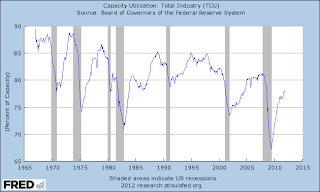
The excessive capital can be seen in the general decline in utilization rates, despite industrial production increasing about 5% annually during the 1990's. The Federal Reserve was now aggressively raising rates to deflate the bubble. Well, they succeeded and it popped, resulting in the stock market falling and the economy slowing. The dramatic nature of the slowdown was an indication of the excess in the system that needed to be worked off, in my view. We were in for a painful, but necessary in my opinion, rationalization of poorly allocated capital. Instead, the extraordinary event of the terrorist attacks on September 11, 2001 occurred and the world became a very scary place. President Bush cut taxes and the Federal Reserve cut rates. Working off the economic excesses was put-off as the country focused on healing and responding.
By 2003 the Fed Funds rate was at 1%, the Bush administration had passed significant tax cuts, and the country had declared war on Iraq. Not only had the economy not had time to work off excesses, the economy was dramatically stimulated by the powerful combination of monetary stimulus, tax cuts and fiscal spending increases. In hindsight, it is not surprising that company profits increased, companies expanded, and housing and retail boomed as rising income and low financing rates made a potent combination. The CPI was creeping up closer to 4% but quickly fell below 2% by the end of 2006 after the Fed Funds rate had been increased above 5% near the start of 2006. I believe the fundamental deflationary forces remained in the form of greater efficiency in business with the maturation of the internet, outsourcing of IT and manufacturing overseas, inexpensive communication due to the excessive investments in fiber optics during the dot-com era, and reorganizations of companies and industries to adapt to the new technologies. However, by 2006 the economy now also had excesses in housing and retail, and was on its way to over-building in shipping.
To summarize to this point, the economy has benefited from "good" deflationary pressure associated with technology advancements. However, a Federal Reserve that has under estimated this fundamental deflationary pressure for decades has now encouraged excessive capital to build-up in segments of the economy. This build-up of excessive investment is now providing additional deflationary pressure on the economy. In short, deflationary pressure has built further, driving interest rates lower and neutering the effectiveness of the Federal Funds rate, in my view.
To be clear, central banks do not act in a vacuum. While the headline CPI inflation data maintains a somewhat inflationary level of around 3%, I believe a closer look shows fundamental deflationary pressures that are pushing interest rates lower. Food, energy and medical expenses are the primary drivers behind higher CPI figures. Both food and energy are directly impacted by the higher commodity prices encouraged by monetary stimulus. The growth in medical expenses is somewhat structural, in my view, due to aging baby boomers and the US health care system. The declining GDP deflator, now around 1% annual growth, offers a clearer insight into deflationary pressures over the past few decades and thus a fundamental reason for falling interest rates, in my view.
The Day the World Change
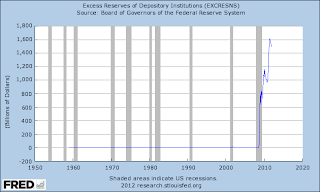
On October 9, 2008 the Federal Reserve made the extraordinary change that it would begin paying interest on both required reserve and excess reserve balances. One of the intended results of paying interest was that the balance of excess reserves held at the Federal Reserve spiked dramatically, making the money multiplier for now irrelevant. Traditionally, interest was not paid on reserves to encourage banks to lend out excess reserves for a profit, creating the money multiplier effect. The Fed increased the monetary base significantly to offset the decline in commercial bank money in the system due to the elimination of the multiplier effect. The change was made in order to enable the Federal Reserve to better control the Federal Funds rate. It also increased the reserves held by the Federal Reserve, providing more firepower to the Fed to use these reserves to purchase securities in the open market, providing liquidity and administering quantitative easing, without materially increasing the amount of credit in the system.
This new policy may eventually lead to a "floor system," in which the Federal Reserve raises the target rate for interbank loans, the Federal Funds rate, by several percentage points to prevent an abundance of credit at a lower interest rate. By setting a floor rate, the Fed removes the incentives for banks to lend in the interbank market or issue loans to the public. With enough excess reserves in the system, the floor system enables the Fed to set interest rates independent of the level of reserves in the system. It also enables the Fed to provide liquidity with additional reserves without impacting interest rates, which it has as liquidity provided by commercial banks has pulled back.
A logical question is why have markets become reliant on government-provided liquidity?
A Shortage of Money?
In my opinion, the Federal Reserve's policies over the past 20-30 years have been a form of price control, attempting to maintain "price stability" in a deflationary environment by aggressively lowering the Federal Funds rate and more recently buying longer-term debt instruments. In essence, for the past 30 years the Federal Reserve has maintained a "price floor" by consistently stimulating the economy through new credit growth in order to keep price rises around 2-3%. Economists generally agree that creating a price floor, which prohibits prices below a certain minimum, causes surpluses. I believe the dot-com bubble, housing bubble, and other excesses in the economy are results of these price controls.
The problem, in my view, is that the Federal Reserve has had diminishing success at stimulating new credit growth. From the commercial banks' perspective, I believe that as interest decline there is a diminishing incentive to make new loans, especially as the yield curve flattens and bad credits from the past accumulate. From the perspective of the renters of money, or businesses requiring financing, a build up in excessive capital in the economy results in a diminishing number of project opportunities offering attractive returns. In short, the demand for new money has slackened due to the build-up in excess capital and the central banks effort to stimulate credit creation is increasingly like "pushing on a string."
A side effect of the excess capital, and compression of return on capital as a result, is that liquidity dries up quickly if commercial banks believe other banks may have problem loans. In other words, the money supplied by commercial banks through the multiplier effect has dried up because lenders are less willing, or less able, to make loans. MZM is the broadest measure of money and is defined as money with zero maturity, or put differently, the supply of financial assets redeemable at par on demand. Monetary base measures the supply of notes and coins, as well as Federal Reserve bank credit. At the start of September 2008, just prior to the liquidity crisis amongst banks, there was about $10 of MZM for every $1 in the monetary base. Just three months later there was about $6 of MZM for every $1 in the monetary base. The ratio has continued to compress with now only $4 of MZM for $1 in the monetary base. While this composition shift in the money supply was largely enabled by quantitative easing, it highlights the growing reliance of the economy on central bank money for liquidity. At present I am unclear whether this increased reliance is good (providing more economic stability during a recession) or bad (a sign of weak demand for new credit due to excessive capital). For now, I simply note our greater reliance on the government for liquidity.
There is some concern among leading economists that the large spike in bank reserves may eventually cause inflation to spike should banks move to quickly increase loans issued, thus reducing reserves and increasing the money multiplier. This theory is very much an exogenous theory of money, which may dominate during normal times. I humbly believe the opposite, or a more endogenous theory on money, is now dominant. The spike in bank reserves is like sirens going off that there are fewer attractive investment opportunities in the economy and that poor performance of past capital allocations must be written off before the economy can re-establish itself on a healthy footing. In other words, I believe we must at some point go through a period of defaults and bankruptcies before moving forward. For a similar argument from a different angle, please refer to this article in EliteTrader.
Where to Now?
The key question is, in my view: How does it end? We could conceivably carry on our merry way for a prolonged period of time. Some market forces enabling the continuation include: (1) investors so worried about suffering loses that they are willing to pay the government for the perceived safety of US government debt, thereby driving yields lower; (2) prices, as measured by the GDP deflator, continue to decline and thereby make even lower yields on treasury attractive, (3) the Federal Reserve continues to monetize stimulative deficit spending by aggressively purchasing treasuries, enabled by a M1 money multiplier of less than 1 that helps avoid inflationary pressures.
While our fairy tale may continue for some time, my guess is that it begins to break down at some point this year. There are a number of issues that likely unfold over the next year that could trigger a rationalization of unattractive capital outlays in the economy, in my view. The European debt problems are a high-profile risk that could precipitate capital flows locking up in the US. How well the Federal reserve can offset liquidity issues should be interesting. However, I think we have enough issues closer to home. The Bush-era tax cuts are scheduled to expire at the end of 2012, which sets up another potentially nasty political fight over tax and spend policies leading to a new tax policy and likely a combination of spending cuts and higher taxes. Additionally, the spending cuts agreed upon to raise the debt ceiling begin to take effect in 2013. The Presidential election cycle this year likely magnifies the economic debates, possibly creating expectations of significant tax increases or spending cuts. These are some pretty strong headwinds for an economy living on fiscal stimulation, debt-driven spending, and Federal Reserve liquidity creation, in my view. We can probably "whistle past the graveyard" for part of 2012, but eventually we have to pay the piper.
Let us not forget that the Federal Reserve itself is under increasing political pressure as both parties look for conflicting outcomes of stimulus and reduced intervention. Does the Federal Reserve apply the brakes to the economy by backing off its actions? How could the Fed politically do such a thing when the near future likely holds some combination of growth inhibiting tax increases and spending cuts? The very existence of the Federal Reserve may be at stake should it appear to be slowing economic growth. While I support the existence of the Federal Reserve, I sometimes question how well its leaders understand the longer-term impact of their actions.
So we may continue falling down this rabbit hole to where one day my bank may actually pay me for the privilege of financing the ownership of my house...okay, not likely.
Throughout last year my main theme of Sagflation was very macroeconomic and top-down. This theme of fundamental deflationary forces in the economy offset by an aggressive monetary policy led me into my large position in 30-year Treasuries last spring. Last April, when I began buying large positions in longer duration treasuries, I received a few raised eyebrows from friends in the investment world who felt treasuries were over-priced. It is at these times, when I'm taking a contrarion view, that I rely on my analysis and knowledge of the markets to provide the intestinal fortitude. I also make sure I have a defined release point, should the markets move against me, in order to cover some downside risk.
Going
forward, I continue to use my Sagflation theme as a back-drop for 2012.
Fundamental deflationary forces remain in play, in my opinion, due to
(1) multiple decades of over-investment fueled by declining interest rates, and
(2) slowing demand as a result of the consumer and sovereign debt
burden. Examples of over-investment include (1) the Baltic Dry Shipping Index down over 90% from 2008 due partially to over-building in ship yards, (2) the on-going weakness in housing, which may have spread to Canada and China, and (3) a glut of retail space, despite recent strong performance by retail REITs, exasperated by a shift to online shopping
(eg. the Borders and Blockbuster bankruptcies).In the following section I review the past thirty years and present my hypothesis that the full deflationary pressure from technology advancements in the 1980's and 1990's went unrecognized by the Federal Reserve. This, in turn, resulted in a targeted inflation rate above what was sustainable, leading to excessive investment and "irrational exuberance." By 2000 there was pent-up deflationary pressure but a combination of extraordinary events and stimulative policy changes have until now offset these deflationary pressures. Indeed, in my view, the deflationary pressure has actually increased over the past decade, resulting in an escalation in the aggressiveness of stimulus measures that increasingly pervert the efficient allocation of capital in the economy.
A Brief Overview of my View on How Deflationary Pressure Built-up
I believe the fundamental deflationary pressure has been building for years, likely beginning in the 1980's with the significant technology advancements during the decade, and continuing through to present day with the business reorganizations that the on-going advancements enabled. Yet the Consumer Price Index averaged around 2.5% for the past 3 decades due largely, in my opinion, to an expansionary bias in the Federal Bank combined with aggressive monetary easing during recessions. On the one side I believe the economy enjoyed falling operating costs within businesses due to improving efficiencies. On the other side the Federal Reserve was targeting an inflation rate around 2-3%, which it expertly maintained by expanding credit in the economy through declining interest rates.
From a central bankers view, I believe they view their role as
maximizing real economic growth by spurring on new credit growth. The
problem, in my mind, is defining "real" growth during periods of
extraordinary fundamental change. By the central bankers failing to accurately quantify deflationary pressures produced by improving efficiencies, their targeted inflation rate of 2-3% was above what was sustainable in the economy, in my view. Businesses with significant information processing requirements enjoyed both falling expenses and potentially rising revenue, expanding their economic profit. The increased profit, in conjunction with falling financing costs associated with declining interest rates, led to heightened investment spending as businesses looked to expand and new competitors entered pursuing the attractive profits, in my view. Therefore, I believe that excess capital was building up in the mid-1990's, increasing demand for money and pumping up asset prices as investors competed for scarce resources, leading to Alan Greenspan's "irrational exuberance" comment in December, 1996.
After Greenspan's comments the markets sold off somewhat in the first half of 1997, as they likely started to factor in the Fed allowing for a recession that would work off the excess capital in the economy. Indeed, the Fed did raise the target Fed Funds rate in order to cool the economy. However, a series of events including the Asian financial crisis in 1997, the default by Russia on its bonds in 1998, and the collapse of Long-Term Capital in September 1998 led the Federal Reserve to reverse course and once again aggressively drop the target Fed Funds rate. Once again US businesses enjoyed expanding profits due to operating efficiencies, which drove up demand for further investments in technology and consulting. Once the worst case scenario appeared averted, the Federal Reserve again began increasing the Fed Funds rate in order to address the rising excess capital, but likely not aggressively enough, in my view. Exasperating the issue was the Fed's decision to increase liquidity in the run-up to Y2K.
By 2000 the economy had about two full decades of excessive stimulus, in my opinion. The stock market was on a tear upwards and the dot-com bubble was almost fully inflated. For anyone who lived through the markets in those times, which I did in San Francisco working for an investment bank focused primarily on technology, it was simply crazy. Talk about excessive capital and inefficient allocations, anything with .com in its name could raise millions while companies generating healthy returns with good growth prospects in the "bricks and mortar" world struggled to be heard. The fuel for this exuberance appears to have been the real world cost improvements of technology investments synchronizing with both the required spending to prepare for Y2K and the dream of a new world created by the internet.
The excessive capital can be seen in the general decline in utilization rates, despite industrial production increasing about 5% annually during the 1990's. The Federal Reserve was now aggressively raising rates to deflate the bubble. Well, they succeeded and it popped, resulting in the stock market falling and the economy slowing. The dramatic nature of the slowdown was an indication of the excess in the system that needed to be worked off, in my view. We were in for a painful, but necessary in my opinion, rationalization of poorly allocated capital. Instead, the extraordinary event of the terrorist attacks on September 11, 2001 occurred and the world became a very scary place. President Bush cut taxes and the Federal Reserve cut rates. Working off the economic excesses was put-off as the country focused on healing and responding. By 2003 the Fed Funds rate was at 1%, the Bush administration had passed significant tax cuts, and the country had declared war on Iraq. Not only had the economy not had time to work off excesses, the economy was dramatically stimulated by the powerful combination of monetary stimulus, tax cuts and fiscal spending increases. In hindsight, it is not surprising that company profits increased, companies expanded, and housing and retail boomed as rising income and low financing rates made a potent combination. The CPI was creeping up closer to 4% but quickly fell below 2% by the end of 2006 after the Fed Funds rate had been increased above 5% near the start of 2006. I believe the fundamental deflationary forces remained in the form of greater efficiency in business with the maturation of the internet, outsourcing of IT and manufacturing overseas, inexpensive communication due to the excessive investments in fiber optics during the dot-com era, and reorganizations of companies and industries to adapt to the new technologies. However, by 2006 the economy now also had excesses in housing and retail, and was on its way to over-building in shipping.
To summarize to this point, the economy has benefited from "good" deflationary pressure associated with technology advancements. However, a Federal Reserve that has under estimated this fundamental deflationary pressure for decades has now encouraged excessive capital to build-up in segments of the economy. This build-up of excessive investment is now providing additional deflationary pressure on the economy. In short, deflationary pressure has built further, driving interest rates lower and neutering the effectiveness of the Federal Funds rate, in my view.
To be clear, central banks do not act in a vacuum. While the headline CPI inflation data maintains a somewhat inflationary level of around 3%, I believe a closer look shows fundamental deflationary pressures that are pushing interest rates lower. Food, energy and medical expenses are the primary drivers behind higher CPI figures. Both food and energy are directly impacted by the higher commodity prices encouraged by monetary stimulus. The growth in medical expenses is somewhat structural, in my view, due to aging baby boomers and the US health care system. The declining GDP deflator, now around 1% annual growth, offers a clearer insight into deflationary pressures over the past few decades and thus a fundamental reason for falling interest rates, in my view.
The Day the World Change
On October 9, 2008 the Federal Reserve made the extraordinary change that it would begin paying interest on both required reserve and excess reserve balances. One of the intended results of paying interest was that the balance of excess reserves held at the Federal Reserve spiked dramatically, making the money multiplier for now irrelevant. Traditionally, interest was not paid on reserves to encourage banks to lend out excess reserves for a profit, creating the money multiplier effect. The Fed increased the monetary base significantly to offset the decline in commercial bank money in the system due to the elimination of the multiplier effect. The change was made in order to enable the Federal Reserve to better control the Federal Funds rate. It also increased the reserves held by the Federal Reserve, providing more firepower to the Fed to use these reserves to purchase securities in the open market, providing liquidity and administering quantitative easing, without materially increasing the amount of credit in the system. This new policy may eventually lead to a "floor system," in which the Federal Reserve raises the target rate for interbank loans, the Federal Funds rate, by several percentage points to prevent an abundance of credit at a lower interest rate. By setting a floor rate, the Fed removes the incentives for banks to lend in the interbank market or issue loans to the public. With enough excess reserves in the system, the floor system enables the Fed to set interest rates independent of the level of reserves in the system. It also enables the Fed to provide liquidity with additional reserves without impacting interest rates, which it has as liquidity provided by commercial banks has pulled back.
A logical question is why have markets become reliant on government-provided liquidity?
A Shortage of Money?
In my opinion, the Federal Reserve's policies over the past 20-30 years have been a form of price control, attempting to maintain "price stability" in a deflationary environment by aggressively lowering the Federal Funds rate and more recently buying longer-term debt instruments. In essence, for the past 30 years the Federal Reserve has maintained a "price floor" by consistently stimulating the economy through new credit growth in order to keep price rises around 2-3%. Economists generally agree that creating a price floor, which prohibits prices below a certain minimum, causes surpluses. I believe the dot-com bubble, housing bubble, and other excesses in the economy are results of these price controls.
The problem, in my view, is that the Federal Reserve has had diminishing success at stimulating new credit growth. From the commercial banks' perspective, I believe that as interest decline there is a diminishing incentive to make new loans, especially as the yield curve flattens and bad credits from the past accumulate. From the perspective of the renters of money, or businesses requiring financing, a build up in excessive capital in the economy results in a diminishing number of project opportunities offering attractive returns. In short, the demand for new money has slackened due to the build-up in excess capital and the central banks effort to stimulate credit creation is increasingly like "pushing on a string."
A side effect of the excess capital, and compression of return on capital as a result, is that liquidity dries up quickly if commercial banks believe other banks may have problem loans. In other words, the money supplied by commercial banks through the multiplier effect has dried up because lenders are less willing, or less able, to make loans. MZM is the broadest measure of money and is defined as money with zero maturity, or put differently, the supply of financial assets redeemable at par on demand. Monetary base measures the supply of notes and coins, as well as Federal Reserve bank credit. At the start of September 2008, just prior to the liquidity crisis amongst banks, there was about $10 of MZM for every $1 in the monetary base. Just three months later there was about $6 of MZM for every $1 in the monetary base. The ratio has continued to compress with now only $4 of MZM for $1 in the monetary base. While this composition shift in the money supply was largely enabled by quantitative easing, it highlights the growing reliance of the economy on central bank money for liquidity. At present I am unclear whether this increased reliance is good (providing more economic stability during a recession) or bad (a sign of weak demand for new credit due to excessive capital). For now, I simply note our greater reliance on the government for liquidity. There is some concern among leading economists that the large spike in bank reserves may eventually cause inflation to spike should banks move to quickly increase loans issued, thus reducing reserves and increasing the money multiplier. This theory is very much an exogenous theory of money, which may dominate during normal times. I humbly believe the opposite, or a more endogenous theory on money, is now dominant. The spike in bank reserves is like sirens going off that there are fewer attractive investment opportunities in the economy and that poor performance of past capital allocations must be written off before the economy can re-establish itself on a healthy footing. In other words, I believe we must at some point go through a period of defaults and bankruptcies before moving forward. For a similar argument from a different angle, please refer to this article in EliteTrader.
Where to Now?
While our fairy tale may continue for some time, my guess is that it begins to break down at some point this year. There are a number of issues that likely unfold over the next year that could trigger a rationalization of unattractive capital outlays in the economy, in my view. The European debt problems are a high-profile risk that could precipitate capital flows locking up in the US. How well the Federal reserve can offset liquidity issues should be interesting. However, I think we have enough issues closer to home. The Bush-era tax cuts are scheduled to expire at the end of 2012, which sets up another potentially nasty political fight over tax and spend policies leading to a new tax policy and likely a combination of spending cuts and higher taxes. Additionally, the spending cuts agreed upon to raise the debt ceiling begin to take effect in 2013. The Presidential election cycle this year likely magnifies the economic debates, possibly creating expectations of significant tax increases or spending cuts. These are some pretty strong headwinds for an economy living on fiscal stimulation, debt-driven spending, and Federal Reserve liquidity creation, in my view. We can probably "whistle past the graveyard" for part of 2012, but eventually we have to pay the piper.
Let us not forget that the Federal Reserve itself is under increasing political pressure as both parties look for conflicting outcomes of stimulus and reduced intervention. Does the Federal Reserve apply the brakes to the economy by backing off its actions? How could the Fed politically do such a thing when the near future likely holds some combination of growth inhibiting tax increases and spending cuts? The very existence of the Federal Reserve may be at stake should it appear to be slowing economic growth. While I support the existence of the Federal Reserve, I sometimes question how well its leaders understand the longer-term impact of their actions.
So we may continue falling down this rabbit hole to where one day my bank may actually pay me for the privilege of financing the ownership of my house...okay, not likely.
Subscribe to:
Posts (Atom)